
Ready to tow with confidence? The TowPro Academy truck towing course covers everything you need — from hitching up correctly to backing a trailer like a pro. One-time payment of $79, access for as long as the course is hosted, 51 video lessons.
Table of Contents
ToggleWhat First-Time Towers Need to Know
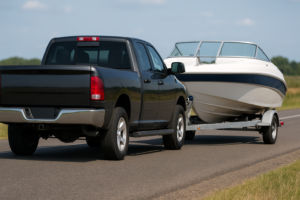
Your first time towing a trailer comes with a steep learning curve — and most of that learning happens in the first five minutes on the road. Whether you’re hauling a utility trailer, a boat, or a camper, these first time towing tips will help you avoid the most common rookie mistakes and get where you’re going safely.Tip #1: Know Your Towing Capacity Before You Hook Anything Up
This is the single most important thing first-timers miss. Your truck or SUV has a maximum towing capacity listed in the owner’s manual — and exceeding it is dangerous. You also need to check your Gross Combined Weight Rating (GCWR), payload capacity, and tongue weight limit. Don’t just assume because you have a “big truck” that you can tow many types of trailers.Tip #2: Get the Hitch Setup Right
Watch a Free Lesson
See how TowPro Academy teaches it step by step. Jeff McDonough, the founder, has 10+ years and 250,000+ miles of towing behind him.
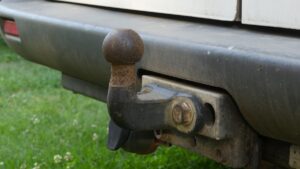
- Confirm the hitch ball size matches the coupler (most common are 1-7/8″, 2″, and 2-5/16″)
- Set the trailer so it tows level — not nose-up or nose-down
- Attach safety chains in a cross pattern under the tongue
- Plug in the trailer wiring and confirm your lights work
- Verify the breakaway cable is connected (if applicable)
Tip #3: Understand How a Trailer Changes Your Driving
A trailer adds length, weight, and inertia. Here’s what actually changes when you drive:- Braking distances increase dramatically — leave twice as much space as you normally would
- Wide turns are now necessary — you’ll swing out and then turn to avoid clipping curbs
- Passing takes much longer — your overall length may be 40+ feet
- Wind and crosswinds affect you more — especially with a large profile trailer
TowPro Academy Course
Stop Guessing. Start Towing Right.
51 video lessons • 950+ pages of downloadable lesson guides • 6 modules • 30-day money-back guarantee. Jeff covers every topic in this article and more — step by step, on video.
Free Download
Never Miss a Safety Check Again
The exact 66-point checklist Jeff runs before every tow, so small problems get caught before they become breakdowns. Enter your email and we will send it over.
Free PDF · Instant download · No spam, unsubscribe any time
Tip #4: Backing Up Is a Skill That Takes Practice
Backing a trailer is counterintuitive. When you turn the wheel left, the trailer goes right. The key trick: place your hand at the bottom of the steering wheel. Move your hand the direction you want the trailer to go. Go slowly. If you jackknife, pull forward and reset. Never try to save a bad backup — just start over.Tip #5: Weight Distribution and Load Placement Matter
About 60% of the trailer’s load should be in front of the axle, 40% behind. Too much weight in the rear causes trailer sway — one of the most dangerous situations you can encounter. Secure all cargo so nothing shifts during the trip.Tip #6: Check Everything Before You Leave
Run through this checklist every single time:- Hitch ball locked and coupler pin in place
- Safety chains attached
- Lights working (brake lights, turn signals, running lights)
- Tire pressure on the trailer
- Load secured and balanced
- Mirrors adjusted to see around the trailer
Final Thoughts
The best first time towing tips all come back to preparation and patience. Take your time, don’t rush, and always do a walk-around check before you hit the road. Want to go from nervous beginner to confident tower? TowPro Academy covers all of this and more in 51 step-by-step video lessons for just $79.Tip #7: Understand Trailer Brakes
Many beginners overlook trailer brakes entirely. In most states, trailers over 1,500–3,000 lbs require their own brakes by law. Even below the legal threshold, electric trailer brakes dramatically shorten stopping distances. If your trailer has electric brakes, you need a brake controller in your truck. A proportional controller is the smoothest and safest option — it applies braking force proportional to how hard you stop. Calibrate the gain to your trailer weight before every trip.Tip #8: Plan Your Route Before You Leave
Route planning changes when you are towing. Check for low clearance structures if your trailer is tall. Locate fuel stops with pull-through lanes so you do not have to back out. On mountain routes, identify long grades where you will need engine braking. Know in advance whether you can turn around if you miss a turn — campgrounds and narrow rural roads can be nearly impossible to reverse out of with a long trailer.Tip #9: Practice in an Empty Lot First
Before your first highway tow, spend 20 to 30 minutes practicing in an empty parking lot. Do wide turns. Try straight backing. Brake with the trailer on. Get a feel for your stopping distance and how wide you need to swing through corners. A quiet shopping center lot after hours works perfectly. Building muscle memory in a zero-pressure environment makes your first real tow far less stressful.Tip #10: Know Your Emergency Responses Before You Need Them
If trailer sway starts: ease off the gas, hold the wheel straight, apply trailer brakes manually if equipped, and let speed drop naturally. Do not brake hard — it will make sway worse. If a trailer tire blows: hold the wheel firmly against the pull, ease off the gas slowly, and steer to the shoulder once speed has dropped. If your transmission temperature warning appears: pull over immediately and let it cool before continuing.The Bottom Line: Confidence Comes One Trip at a Time
Every experienced tower started exactly where you are now. The hyper-awareness, the second-guessing on lane changes, the triple-checking before every stop — that fades quickly once you have a few successful hauls behind you. Start with a smaller, lighter trailer. Take your time. Do a thorough pre-trip inspection every single time. Each safe tow builds the skill and confidence to tackle the next one.Understanding Towing Laws and Regulations
Before your first tow, it is worth knowing a few basic legal requirements that vary by state:- Trailer brake requirements: Most states require trailers over a certain weight (typically 1,500–3,000 lbs) to have their own brakes. Driving without required brakes is both illegal and dangerous.
- Speed limits: Many states have lower speed limits for vehicles towing trailers — often 55 mph even on 65 mph highways. Check the laws in every state on your route.
- Mirror requirements: If your trailer is wider than your tow vehicle, extended towing mirrors are legally required in most states.
- Registration: Most trailers require their own registration and license plate. Utility trailers, travel trailers, and boat trailers all typically need to be registered separately from your tow vehicle.
- Safety chain rules: Safety chains are required in virtually every state. The crossing pattern (chains crossed under the tongue) is also required in many states.
Towing Mirrors: Why They Are Essential
One of the most important and overlooked pieces of towing equipment is the right mirrors. If you cannot see along both sides of your trailer and behind it, you should not be on the road. Most pickup trucks have mirrors that are insufficient for seeing behind wider trailers, especially travel trailers and boat trailers wider than the truck.Clip-on towing mirror extensions are inexpensive (often under $50 a pair) and attach to your existing mirrors to extend your field of view. They are not as good as factory towing mirrors, but they are far better than nothing. If you tow regularly, investing in factory-style towing mirrors specific to your truck is worth the expense — they fold flat when not towing and extend when needed.Before every tow, sit in the driver seat and confirm you can see both the rear corners of your trailer clearly in your mirrors. If you cannot, adjust until you can — or get mirror extensions before you leave the driveway.What Happens to Your Vehicle While Towing
Towing puts your vehicle under stresses it does not experience during normal driving. Understanding what is happening mechanically helps you make better decisions on the road:- Transmission: Towing generates significant heat in automatic transmissions. Long grades, stop-and-go traffic, and high ambient temperatures all increase transmission temperature. Use your truck’s tow/haul mode (if equipped) to activate higher RPM shift points that reduce heat buildup.
- Engine cooling: The engine works harder while towing, and the cooling system works harder as a result. Make sure your coolant is fresh and at the proper level before towing in hot weather or mountainous terrain.
- Brakes: Your truck’s brakes are handling more inertia when towing. Brake fade on long descents is a real risk. Use engine braking (lower gears) on long grades instead of riding the brakes.
- Tires: Rear tires carry extra load when towing. Check rear tire pressure before each trip — many trucks specify slightly higher pressures when towing. Overloaded, underinflated tires generate heat and can fail.
Stop guessing. Start towing with confidence.
The TowPro Course walks you through every skill in real road scenarios.
Step-by-step video lessons, a final exam, and printable lesson guides and checklists — everything in one place for $79 (fall special, reg. $99).
Enroll Now — $79 (Fall Special, reg. $99) →About the Author
Jeff McDonough
Founder of TowPro Academy, 10+ years and 250,000+ miles of towing experience.
He built TowPro Academy to give everyday trailer owners a clear, step-by-step way to learn what he learned on the road.
Read Full Bio →RELATED ARTICLES
- ›How to Buy a Used Trailer: What to Look For Before You Commit
- ›Towing Uphill and Downhill: How to Handle Grades Safely
- ›How to Parallel Park a Trailer (Step-by-Step)
- ›How to Read Your Truck’s Towing Specs (Owner’s Manual Guide)
Ready to put it all together? Enroll in TowPro Academy and master safe towing in 51 step-by-step lessons.
Related Articles

Learn It Right the First Time
- 51 video lessons, hitching to backing to emergencies
- 950+ pages of PDF guides and checklists
- Final exam: score 80% to earn your certificate of completion
- 30-day refund if it is not for you
$79 through Oct 31 (regularly $99)