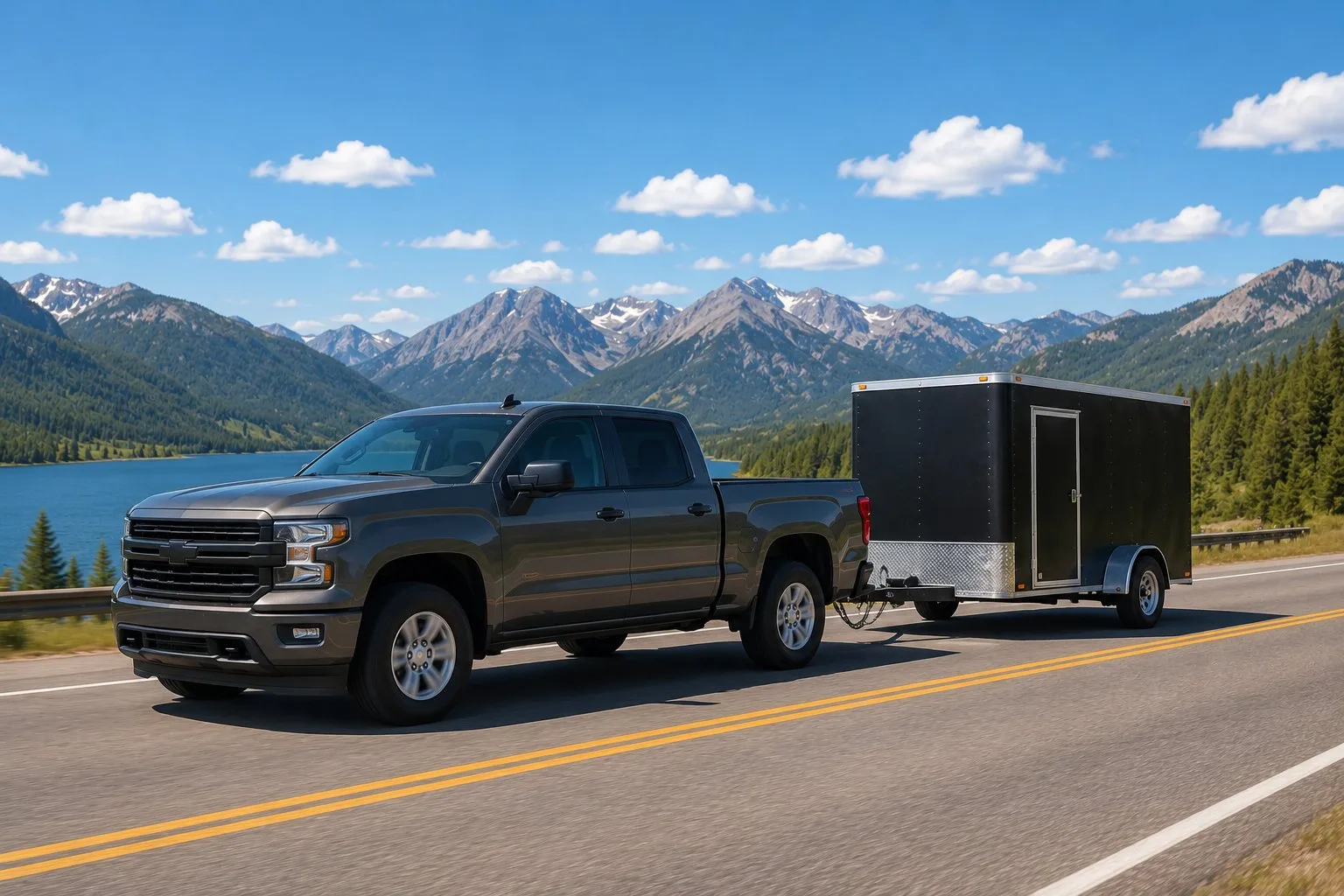
The fifth wheel vs gooseneck debate is one of the most common questions for heavy-duty towers — and bumper pull is the third option worth understanding too. When most people think of towing, they picture a ball hitch on the back of a truck. But understanding the differences between all three configurations helps you choose the right one for your setup.
Want structured, step-by-step training? Check out our guide to getting towing certified online to learn everything you need to tow with confidence.
Bumper Pull (Weight-Distributing Ball Hitch)
How It Works
A bumper pull hitch uses a ball mounted on a hitch receiver at the rear of the truck. The trailer coupler — a socket that fits over the hitch ball — connects the trailer to the truck. The connection point is behind the rear axle, which means trailer tongue weight adds leverage that can lift the truck’s front wheels if not managed with a weight distribution hitch.
Towing Capacity
Bumper pull (also called tag-along or conventional) hitches are rated by class:
- Class I: Up to 2,000 lbs GTW / 200 lbs tongue weight
- Class II: Up to 3,500 lbs GTW / 350 lbs tongue weight
- Class III: Up to 8,000 lbs GTW / 800 lbs tongue weight
- Class IV: Up to 10,000 lbs GTW / 1,000 lbs tongue weight
- Class V: Up to 20,000 lbs GTW / 2,000 lbs tongue weight (requires weight distribution)
In practice, bumper pull is ideal for most travel trailers, utility trailers, boat trailers, horse trailers up to about 15,000 lbs, and cargo trailers. For loads up to about 10,000–12,000 lbs, it’s the simplest and most versatile option.
READY TO STOP GUESSING?
LEARN THE RIGHT WAY. BUILD THE SKILLS TO TOW MORE SAFELY.
Build the skills to tow more safely. 51 video lessons, one-time payment.
ENROLL NOWOne-time payment - 30-Day money-back guarantee
Pros
- Works with any truck with a standard receiver hitch
- Trailer is easy to couple and decouple
- Same truck can tow many different trailers
- Lower cost for both hitch and trailer
- Full bed access — nothing mounted in the truck bed
Cons
- Connection behind the rear axle creates leverage that can cause front-end lift on heavy loads
- More prone to sway on heavy loads without a sway control device or weight distribution hitch
- Lower maximum towing capacity than in-bed systems
- Requires weight distribution hitch for trailers over ~6,000 lbs on most half-tons
Best For
Travel trailers under 12,000 lbs, utility trailers, boat trailers, horse trailers, enclosed cargo trailers, and anyone who tows a variety of different trailers or doesn’t tow frequently enough to justify an in-bed hitch system.
Fifth Wheel Hitch
How It Works
A fifth wheel hitch mounts in the truck bed, typically over or slightly forward of the rear axle. The trailer has a kingpin that locks into the fifth wheel coupling — the same system used by semi trucks and commercial trailers. Because the hitch point is over the rear axle (not behind it), the tongue weight is much better distributed and the leverage problem of bumper pull is eliminated.
Towing Capacity
Fifth wheel hitches typically range from 16,000 to 30,000+ lbs capacity. Because the hitch is over the axle, three-quarter-ton and one-ton trucks can safely handle the tongue weight (typically 20–25% of GTW on a fifth wheel, compared to 10–15% on a bumper pull). A one-ton dually with a fifth wheel is the standard setup for large RVs.
Pros
- Much more stable than bumper pull at higher weights — sway is virtually eliminated
- Higher towing capacity — suitable for large RVs and heavy horse trailers
- Hitch point over the axle means better weight distribution with no front-end lift
- Easier to couple than gooseneck — the kingpin guides itself into the coupling
- Smoother ride due to the pivot point location
Cons
- Takes up significant truck bed space — reduces bed access and usable length
- Hitch must be removed for regular bed use (some sliding models help with this)
- Only works with fifth wheel trailers — not compatible with bumper pull or gooseneck trailers
- Higher cost than a ball hitch system
- Requires a 3/4-ton or 1-ton truck for most applications
Best For
Large RVs and fifth wheel travel trailers, full-time RVers, and anyone towing a dedicated trailer over 15,000 lbs who prioritizes stability and ride quality over bed utility.
Free Download
Never Miss a Safety Check Again
The exact 66-point checklist Jeff runs before every tow, so small problems get caught before they become breakdowns. Enter your email and we will send it over.
Free PDF · Instant download · No spam, unsubscribe any time
Gooseneck Hitch
Watch a Free Lesson
See how TowPro Academy teaches it step by step. Jeff McDonough, the founder, has 10+ years and 250,000+ miles of towing behind him.
How It Works
A gooseneck hitch also mounts in the truck bed, but uses a ball-and-coupler system instead of a kingpin. The gooseneck trailer has a downward-curved neck (the “gooseneck”) that arcs over the truck bed and down to a coupler that fits over a 2-5/16″ ball in the truck bed. Like a fifth wheel, the hitch point is over the rear axle.
Towing Capacity
Gooseneck hitches typically offer the highest towing capacities of any hitch type — 30,000 lbs and above on heavy-duty one-ton trucks. They’re the preferred system for commercial applications: livestock trailers, heavy equipment haulers, flatbed goosenecks, and large cargo trailers.
Pros
- Highest towing capacity of any hitch type
- Hitch ball folds flat into the truck bed when not in use — full bed access restored
- Better articulation than fifth wheel in tight turns (gooseneck can flex more)
- Lower profile in the bed than a fifth wheel hitch head
- More affordable than fifth wheel hitch hardware
Cons
- More difficult to couple — you must back precisely over the ball with limited visibility
- Gooseneck trailers are mostly commercial/agricultural — few recreational trailers use gooseneck
- Slightly less stable ride feel than fifth wheel due to the single ball-and-socket connection vs. fifth wheel’s flat plate pivot
- Not compatible with fifth wheel or bumper pull trailers
Best For
Commercial use: livestock trailers, heavy equipment trailers, flatbeds, and large cargo hauling. Also popular with horse trailer owners who want maximum capacity and clean bed access when not towing.
Head-to-Head Comparison
Here’s a quick-reference breakdown of the three hitch types across the key decision factors:
- Maximum capacity: Gooseneck > Fifth Wheel > Bumper Pull
- Stability at speed: Fifth Wheel ≈ Gooseneck > Bumper Pull
- Ease of coupling: Bumper Pull > Fifth Wheel > Gooseneck
- Bed access: Bumper Pull > Gooseneck > Fifth Wheel
- Versatility (multiple trailers): Bumper Pull > Gooseneck > Fifth Wheel
- Cost: Bumper Pull (lowest) < Gooseneck < Fifth Wheel (highest)
- Best trailer types: Bumper Pull: travel trailers, utility, boat. Fifth Wheel: large RVs. Gooseneck: livestock, equipment, flatbed.
Can You Convert Between Systems?
Combination hitches exist that allow gooseneck-to-fifth-wheel adapters and gooseneck-to-bumper-pull adapters. These work for occasional use but are not recommended as primary setups for heavy loads — they introduce an additional coupling point and reduce rated capacity. For regular towing, use the system your trailer was designed for.
Which System Is Right for You?
For most everyday towers pulling a travel trailer, boat, utility trailer, or horse trailer under 12,000 lbs: bumper pull with a proper weight-distributing hitch is the right answer. It’s versatile, works with multiple trailers, and leaves your truck bed usable.
If you’re buying a large fifth wheel RV or pulling trailers consistently over 15,000 lbs with an eye on stability and ride quality: fifth wheel is the right choice.
If you’re in agriculture, ranching, construction, or regularly hauling heavy equipment over 20,000 lbs: gooseneck is built for you. For more on commercial coupling standards and fifth wheel specifications, the FMCSA 49 CFR §393.71 outlines federal standards for fifth wheel coupling systems used on commercial vehicles.
TowPro Academy’s towing course covers hitch selection, weight distribution setup, and everything you need to configure your rig correctly from day one. Enroll for $79 — one-time payment, 51 video lessons, access for as long as the course is hosted.
Further Reading
- Towing Capacity Explained: How to Find Your Truck’s Limit and Why It Matters
- Weight Distribution Hitch Setup: How to Do It Right (Step-by-Step)
- How to Choose a Trailer Hitch: The Complete Guide for Truck Owners
Ready to Tow With Confidence?
TowPro Academy is a online trailer towing course built for truck owners who tow their own trailers. 51 lessons covering everything from hookup to backing up — one-time payment, learn at your own pace.
Read Next
- RV Towing for Beginners
- What Is GCWR?
- Towing Glossary
- New to Towing? Start Here
- Complete Beginner’s Guide to Trailer Towing
Learn It Right the First Time
- 51 video lessons, hitching to backing to emergencies
- 950+ pages of PDF guides and checklists
- Final exam: score 80% to earn your certificate of completion
- 30-day refund if it is not for you
$79 through Oct 31 (regularly $99)
Frequently Asked Questions
What’s the difference between fifth wheel, gooseneck, and bumper pull hitches?
Bumper pull hitches mount at the rear and suit lighter trailers. Fifth wheel and gooseneck hitches mount in the truck bed over the axle, offering greater stability and much higher towing capacity for large trailers.
Which hitch type can tow the most weight?
Gooseneck hitches typically handle the highest weights, often 30,000 pounds or more, followed closely by fifth wheels. Bumper pull setups are limited to lighter loads by comparison.
Are fifth wheel trailers easier to tow than bumper pulls?
Generally yes. Because the load sits over the truck’s rear axle, fifth wheels track more stably, resist sway, and turn more tightly than a comparable bumper pull trailer.
Can I put a gooseneck hitch on any truck?
Only trucks with a bed and adequate frame and payload capacity can safely use a gooseneck or fifth wheel hitch. Always confirm your truck’s tow and payload ratings before installing one.
Heavier fifth-wheel and gooseneck setups can push you past what a regular license covers in some states. See Do You Need a Special License to Tow a Trailer?
Stop guessing. Start towing with confidence.
The TowPro Course walks you through every skill in real road scenarios.
Step-by-step video lessons, a final exam, and printable lesson guides and checklists — everything in one place for $79 (fall special, reg. $99).
Enroll Now — $79 (Fall Special, reg. $99) →RELATED ARTICLES
- ›Night Towing: Tips and Techniques for Safe After-Dark Driving
- ›How to Buy a Used Trailer: What to Look For Before You Commit
- ›Towing Laws by State: What Every Driver Needs to Know
- ›Trailer Maintenance Schedule: What to Inspect, When, and Why
Ready to put it all together? Enroll in TowPro Academy and master safe towing in 51 step-by-step lessons.