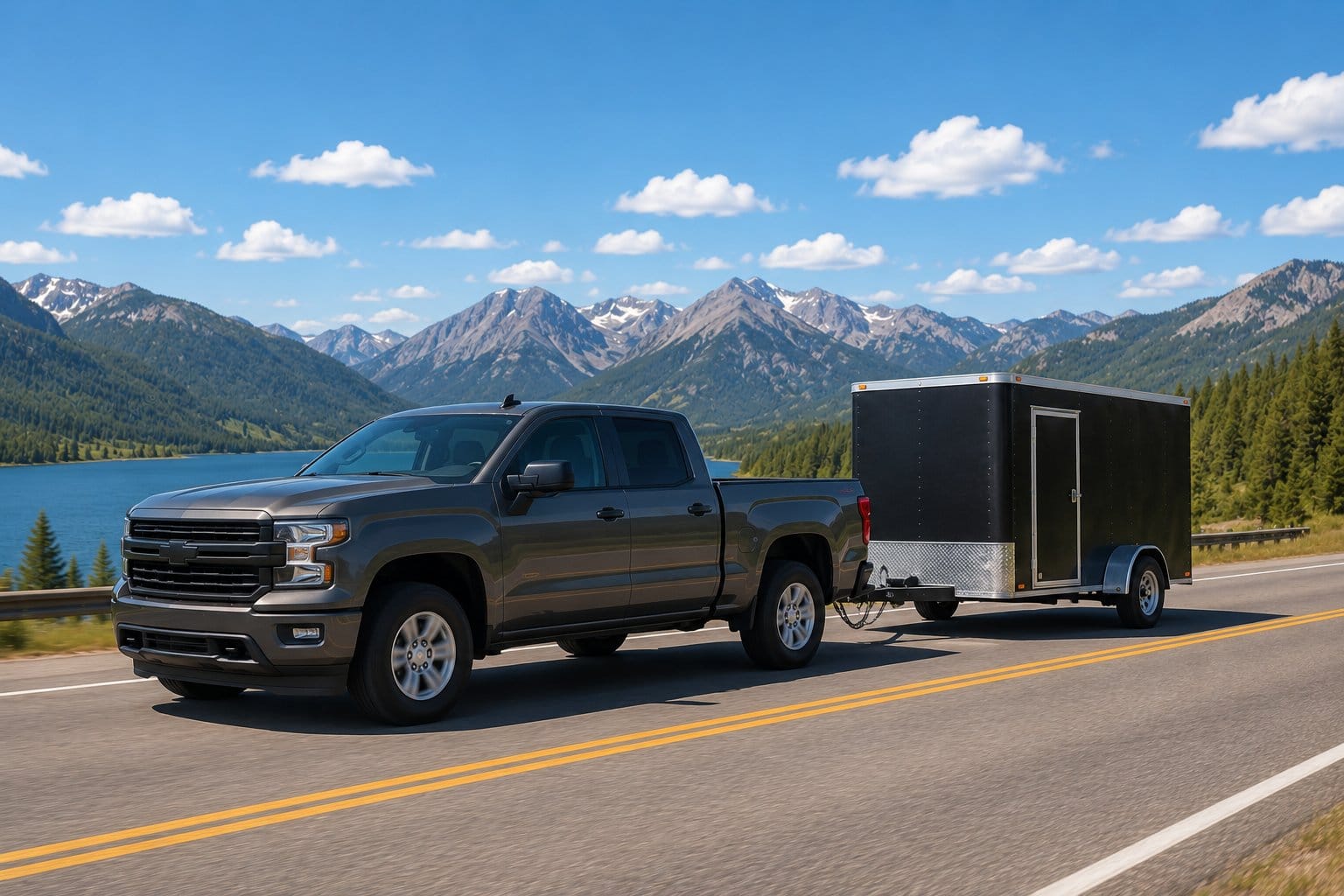
How to choose a trailer hitch is one of the first questions every new tower runs into — and one of the most confusing. Walk into any trailer supply store and you’ll find rows of balls, shanks, receivers, and weight ratings, none of which come with a plain-English explanation. Get it wrong and your trailer could disconnect on the highway or your truck could be damaged from overloading. Get it right and you’ll tow safely for years without a second thought.
This guide cuts through the confusion. By the end, you’ll know exactly which hitch class you need, how to match your ball size to your trailer, and what weight ratings actually mean — so you can buy with confidence and tow safely.
TowPro Academy Course
Stop Guessing. Start Towing Right.
51 video lessons • 950+ pages of downloadable lesson guides • 6 modules • 30-day money-back guarantee. Jeff covers every topic in this article and more — step by step, on video.
Enroll Now — $79 through Oct 31 (regularly $99)Access for as long as the course is hosted • No subscriptionWhat Is a Trailer Hitch?
A trailer hitch is the receiver assembly that bolts to the frame of your tow vehicle and provides the connection point for a trailer. It’s the foundation of your entire towing setup — everything else (ball mount, hitch ball, safety chains, trailer connector) connects through it.
The hitch itself is a steel receiver — typically a square tube opening — that accepts interchangeable ball mounts. This means your hitch stays on the truck permanently while you swap out different ball mounts for different trailers. Most modern truck hitches use either a 1-1/4-inch or 2-inch receiver opening.
Choosing the right trailer hitch starts with two questions: What is your vehicle rated to tow? and How heavy is your trailer? If you haven’t checked your truck’s towing capacity yet, start there — our guide to towing capacity explained walks you through exactly how to find your truck’s real-world limit.
Hitch Classes Explained (Class I Through V)
Trailer hitches are divided into five classes based on their maximum gross trailer weight (GTW) rating and tongue weight capacity. Here’s what each class is designed for:
READY TO STOP GUESSING?
LEARN THE RIGHT WAY. BUILD THE SKILLS TO TOW MORE SAFELY.
Build the skills to tow more safely. 51 video lessons, one-time payment.
ENROLL NOWOne-time payment - 30-Day money-back guarantee
For a deeper dive into each class with weight ratings and use-case examples, see our full trailer hitch classes guide.
Class I — Light Duty (up to 2,000 lbs GTW)
Class I hitches use a 1-1/4-inch receiver and are designed for small cars and crossovers towing lightweight loads — small utility trailers, bicycle racks, or cargo carriers. If you’re towing a boat, camper, or anything substantial with a full-size truck, this is not your hitch.
Class II — Medium Light Duty (up to 3,500 lbs GTW)
Class II hitches also use a 1-1/4-inch receiver but have a higher weight rating. They’re common on minivans, small SUVs, and mid-size sedans. Suitable for small trailers, pop-up campers, and lightweight boat trailers. Still not the right choice for a full-size pickup application.
Class III — Standard Duty (up to 8,000 lbs GTW)
Class III is the most common hitch for everyday truck and SUV towing. It uses a 2-inch receiver and handles the majority of recreational towing — boats up to about 6,000–7,000 lbs, travel trailers, horse trailers, enclosed cargo trailers, and utility trailers. If you own a half-ton truck and tow recreationally, this is almost certainly your class.
Class IV — Heavy Duty (up to 12,000 lbs GTW)
Class IV uses a 2-inch receiver and is designed for heavier towing on three-quarter-ton and one-ton trucks. If you’re towing a large fifth-wheel-compatible trailer, a heavy boat, or a loaded gooseneck trailer with a standard receiver, you’re in Class IV territory. Many newer heavy-duty trucks come with Class IV hitches from the factory.
Class V — Extra Heavy Duty (up to 20,000 lbs GTW)
Class V hitches use a 2-1/2-inch receiver and are built for serious commercial and agricultural towing — large horse trailers, heavy equipment, and fifth-wheel setups. If you’re asking whether you need a Class V, you almost certainly don’t for recreational purposes.
Quick rule of thumb for most truck owners: If your truck is a half-ton (F-150, Ram 1500, Silverado 1500, Tundra), you need a Class III. If it’s a three-quarter-ton or one-ton (F-250/350, Ram 2500/3500, Silverado 2500/3500), look at Class IV.
How to Match Your Ball Size to Your Trailer
Watch a Free Lesson
See how TowPro Academy teaches it step by step. Jeff McDonough, the founder, has 10+ years and 250,000+ miles of towing behind him.
The hitch ball is the steel ball that the trailer coupler locks onto. Ball size must exactly match the trailer coupler size — there’s no “close enough.” Using a mismatched ball is one of the most dangerous mistakes in towing and can result in the trailer disconnecting at highway speed.
There are three common ball sizes for recreational towing:
1-7/8 Inch Ball
Used on lightweight trailers — small utility trailers, jet ski trailers, and folding pop-up campers. Rated for trailers up to about 2,000 lbs. Less common on full-size trucks but you may encounter it with small specialty trailers.
2 Inch Ball
The most common ball size for recreational truck towing. Rated up to 10,000–12,000 lbs depending on the ball’s shank diameter and the receiver class. Boat trailers, travel trailers, horse trailers, and most utility trailers use a 2-inch coupler. This is the size the vast majority of everyday towers use.
2-5/16 Inch Ball
Used for heavier trailers — larger travel trailers and fifth-wheel trailers with conventional couplers. Rated up to 30,000 lbs. If your travel trailer or RV is on the heavier end, check the coupler size on the trailer tongue before assuming you need a 2-inch ball.
How to find your trailer’s required ball size: Check the coupler on the trailer tongue — the required ball size is stamped directly on the coupler latch. It will read 1-7/8″, 2″, or 2-5/16″. Match that number exactly.
Free Download
Never Miss a Safety Check Again
The exact 66-point checklist Jeff runs before every tow, so small problems get caught before they become breakdowns. Enter your email and we will send it over.
Free PDF · Instant download · No spam, unsubscribe any time
Understanding Weight Ratings: GTW and TW
Every trailer hitch has two critical weight ratings stamped on it. Understanding these is essential to choosing a trailer hitch that’s actually safe for your setup.
Gross Trailer Weight (GTW)
GTW is the maximum total weight of the loaded trailer — the trailer itself plus everything inside it. This is the number most people focus on, and rightfully so. If your hitch is rated for 8,000 lbs GTW and your loaded trailer weighs 9,500 lbs, you’re overloading your hitch and putting yourself and others at serious risk.
GTW must never exceed either the hitch rating or your vehicle’s towing capacity — whichever is lower wins. A hitch rated for 8,000 lbs doesn’t help you if your truck is only rated to tow 6,500 lbs.
Tongue Weight (TW)
Tongue weight is the downward force the trailer tongue exerts on the hitch ball. It must fall within a specific range — typically 10–15% of the total trailer weight — to prevent trailer sway. Too little tongue weight and the trailer fishtails; too much and your truck’s rear squats, killing steering and braking response.
Your hitch has a maximum tongue weight rating just like it has a GTW rating. Check both before you load and go. Most Class III hitches have a tongue weight rating between 800 and 1,000 lbs. If your trailer needs more tongue weight than your hitch supports, you need either a higher-class hitch or a weight distribution system.
Hitch Receiver Sizes: 1-1/4 vs 2 Inch
The receiver opening is the square tube on your hitch that accepts ball mounts and accessories. The two most common sizes are 1-1/4 inch and 2 inch.
A 1-1/4-inch receiver is standard on Class I and II hitches — lighter vehicles doing lighter towing. Ball mounts, bike racks, and cargo carriers for 1-1/4-inch receivers are widely available but have lower weight ratings.
A 2-inch receiver is the standard for Class III and IV hitches — which covers virtually all full-size truck and heavy-duty SUV towing. The 2-inch receiver gives you access to the full range of ball mounts, weight distribution hitches, sway control bars, and accessories.
If your truck came from the factory with a 2-inch receiver hitch (very common on F-150s, Ram 1500s, and Silverados), you’re already set for Class III towing — you may only need to buy a ball mount and ball to get started.
Do You Need a Weight Distribution Hitch?
A weight distribution hitch is a specialized system that uses spring bars to redistribute the tongue weight of the trailer across all four wheels of the tow vehicle — instead of letting it all concentrate on the rear axle. The result is a level tow vehicle, better steering response, and more stable braking.
You likely need a weight distribution hitch if any of the following apply:
- Your trailer weighs more than 50% of your tow vehicle’s curb weight
- Your truck’s front end lifts or the headlights point upward when the trailer is hitched
- You notice loose steering or reduced braking performance when towing
- Your tongue weight exceeds your standard hitch’s tongue weight rating
- You’re towing a travel trailer or fifth-wheel heavier than about 6,000 lbs
Weight distribution hitches are also one of the most effective tools for preventing trailer sway, since they keep the entire rig level and balanced. If you’ve ever experienced or are worried about sway, our dedicated guide to trailer sway control explains exactly how weight distribution and sway control work together.
The main downside of weight distribution hitches is cost ($300–$800 for quality units) and the extra setup time when hitching. For occasional recreational towing of moderate loads, a standard ball mount on a Class III receiver is perfectly adequate.
Installation: Dealer, Shop, or DIY?
Most receiver hitches bolt to the vehicle’s frame using existing holes — no drilling or welding required. Many experienced truck owners install their own hitches in an afternoon with basic tools. That said, there are a few things to be aware of:
DIY Installation
If your hitch is vehicle-specific and uses existing frame holes, DIY installation is straightforward. Buy a hitch that’s explicitly fit-listed for your year, make, and model. Torque the bolts to spec using a torque wrench — under-torqued hitch bolts can loosen over time and allow the hitch to shift. Plan for 1–2 hours your first time. The job gets easier with a second person to hold the hitch in position while you start the bolts.
Professional Installation
U-Haul, trailer supply stores (like Tractor Supply or etrailer dealers), and independent shops typically install hitches for $60–$150 in labor. If you’re not comfortable under the vehicle or don’t have the tools, professional installation is money well spent. Ask them to torque the bolts to spec and show you the installed hitch before you drive away.
What to Check After Installation
Before your first tow, inspect every bolt for tightness. Rock the hitch by hand — there should be zero movement. Check that the receiver opening is square and level with the ground. Once you’re towing, re-check the torque after the first 50 miles, as bolts can seat and settle slightly under load. Add hitch inspection to your regular pre-trip towing checklist.
Learn It Right the First Time
- 51 video lessons, hitching to backing to emergencies
- 950+ pages of PDF guides and checklists
- Final exam: score 80% to earn your certificate of completion
- 30-day refund if it is not for you
$79 through Oct 31 (regularly $99)
Frequently Asked Questions About Choosing a Trailer Hitch
What hitch class do I need for a travel trailer?
Most travel trailers in the 3,000–8,000 lb range require a Class III hitch with a 2-inch receiver. Heavier travel trailers above 8,000 lbs may require a Class IV hitch and almost certainly benefit from a weight distribution system. Always check your specific trailer’s GTW and tongue weight against the hitch and vehicle ratings.
What hitch do I need to tow a boat?
For most recreational boat towing with a full-size truck, a Class III hitch with a 2-inch receiver and a 2-inch ball is the standard setup. Small Jon boats and personal watercraft on lightweight trailers may only need a Class II with a 1-7/8-inch ball. Check your boat trailer’s coupler size and GTW rating, then match your hitch class accordingly.
Does my truck already have a hitch?
Many modern trucks come with a factory-installed receiver hitch, especially higher trims. Check the rear bumper area for a square receiver opening. If you see a 2-inch square tube with a hole for a hitch pin, you likely already have a Class III hitch installed. You may only need to purchase a ball mount and hitch ball to start towing.
What is drop in a ball mount and why does it matter?
The “drop” on a ball mount refers to how far the ball sits below the receiver opening. This is important because the trailer coupler needs to be level when hitched — neither nose-up nor nose-down. Measure the height of your receiver from the ground, then measure the trailer coupler height. The difference tells you how much drop (or rise) you need in your ball mount. A trailer that’s hitched nose-down can cause dangerous rear weight shifts and sway.
How do I know if my hitch is rated for my trailer?
Look for a sticker or stamp on the hitch receiver that lists the GTW (gross trailer weight) and TW (tongue weight) ratings. Compare those numbers to your loaded trailer’s actual weight and tongue weight. Both numbers must be within the hitch’s rated limits — and within your vehicle’s towing capacity. When in doubt, weigh your loaded trailer at a public truck scale before your first trip.
Can I use a hitch that’s rated higher than I need?
Yes — a higher-rated hitch doesn’t hurt anything and gives you flexibility as your towing needs grow. Many truck owners install a Class IV hitch on a vehicle that currently tows Class III loads, just to have the extra capacity. The only downside is slightly higher cost and weight.
Choosing the right trailer hitch comes down to matching three numbers: your trailer’s GTW, your trailer’s tongue weight, and your vehicle’s towing capacity. Get those right, select the appropriate hitch class, match the ball size to the coupler, and you’re set up to tow safely.
But a proper hitch is just the beginning. Knowing how to connect it correctly, load the trailer for stability, and drive with a trailer in tow — that’s where real confidence comes from. TowPro Academy’s truck towing course covers all of it: hitch setup, weight distribution, pre-trip inspection, backing, emergency handling, and more. 51 video lessons, 950+ pages of downloadable lesson guides — everything an everyday truck owner needs to tow safely.
Got your hitch sorted? Make sure the rest of your rig is ready too — our Memorial Day Weekend Towing Tips covers loading, traffic strategy, summer heat, and campground arrival so you can make the most of the holiday weekend.
Get started with TowPro Academy today — access for as long as the course is hosted for a one-time payment of only $79.
Related: After choosing your hitch, make sure you pair it with the right ball. Our guide on trailer ball sizes and weight ratings covers everything — diameter, shank size, and how to verify your ball is correctly matched to your coupler. Trailer hitch receiver classes are defined by the SAE J684 standard, the industry specification that establishes weight ratings and dimensions for Class I through Class V hitches used across North America.
What are the different trailer hitch classes?
Trailer hitches come in five classes: Class I (1.25″ receiver, up to 2,000 lbs) for small cars; Class II (1.25″ receiver, up to 3,500 lbs) for mid-size vehicles; Class III (2″ receiver, up to 8,000 lbs) for most trucks and SUVs; Class IV (2″ receiver, up to 10,000 lbs) for heavy-duty trucks; Class V (2.5″ receiver, 18,000+ lbs) for maximum-duty towing. Most 3/4-ton trucks use Class III, IV, or V hitches.
What size trailer ball do I need?
Trailer ball size is determined by your trailer’s coupler size, stamped on the coupler or in your trailer’s manual. The three most common sizes are: 1-7/8 inch for light trailers under 3,500 lbs, 2 inch for most travel trailers and boat trailers, and 2-5/16 inch for heavy trailers over 10,000 lbs. Always match ball to coupler exactly — using the wrong size is dangerous.
How do I know if my hitch is the right height?
The trailer coupler and hitch ball should be at the same height when connected, creating a level trailer. Check with a phone level app. If the trailer noses down, use a rise ball mount; if it noses up, use a drop mount. An unlevel trailer alters tongue weight distribution and can cause handling problems.
Do I need a weight distribution hitch?
A weight distribution hitch is recommended when tongue weight exceeds 10% of your front axle rating, when your truck noticeably squats at the rear when hitched, or when trailer weight exceeds 50% of the tow vehicle’s weight. Most 3/4-ton truck owners towing trailers over 6,000–8,000 lbs benefit from weight distribution.
Can I install a trailer hitch myself?
Yes — most receiver hitches bolt directly to existing frame mounting points in 30–90 minutes with basic hand tools. No welding or fabrication is needed. Use a hitch rated specifically for your vehicle, torque all bolts to spec, and verify the installation before towing. Wiring harnesses also require only basic plug-in connections on most modern vehicles.
Related Articles
- What Is GVWR?
- What Is Payload Capacity?
- Towing Capacity Explained
- Trailer Sway Control Guide
- Towing Glossary: Every Key Towing Term Defined
Ready to Tow With Confidence?
TowPro Academy is a online trailer towing course built for truck owners who tow their own trailers. 51 lessons covering everything from hookup to backing up — one-time payment, learn at your own pace.
Start the Course — $79 One-TimeStop guessing. Start towing with confidence.
The TowPro Course walks you through every skill in real road scenarios.
Step-by-step video lessons, a final exam, and printable lesson guides and checklists — everything in one place for $79 (fall special, reg. $99).
Enroll Now — $79 (Fall Special, reg. $99) →Read Next
- What Is Tongue Weight?
- What Is a Weight Distribution Hitch?
- Towing Capacity Guide
- Complete Beginner’s Guide to Trailer Towing
- Full Towing Glossary
RELATED ARTICLES
- ›Night Towing: Tips and Techniques for Safe After-Dark Driving
- ›How to Buy a Used Trailer: What to Look For Before You Commit
- ›Towing Laws by State: What Every Driver Needs to Know
- ›Trailer Maintenance Schedule: What to Inspect, When, and Why
Ready to put it all together? Enroll in TowPro Academy and master safe towing in 51 step-by-step lessons.