Choosing the Right Tow Vehicle for Your Dump Trailer
Choosing a tow vehicle for a dump trailer is a payload problem as much as a towing problem. A dump trailer’s whole purpose is to haul dense, heavy material, so the numbers that matter are not just how much the truck can pull, but how much tongue weight it can carry and how well it can stop a heavy, low-slung load. This guide focuses on the specific demands dump trailers place on a tow vehicle.
Why Dump Trailers Demand More Truck
A dump trailer is heavy before you load it, and its payload, soil, gravel, concrete, is far denser than the cargo most trailers carry. That means both the trailer’s gross weight and its tongue weight climb quickly. A tow vehicle that comfortably pulls a lightweight utility trailer can be badly overmatched by a loaded dump trailer of the same footprint, so start by looking at your real loaded weights, not the empty trailer.
Towing Capacity vs Payload for Dump Trailers
Watch a Free Lesson
See how TowPro Academy teaches it step by step. Jeff McDonough, the founder, has 10+ years and 250,000+ miles of towing behind him.
Towing capacity gets the attention, but payload capacity is usually the limiting factor with a dump trailer. Tongue weight, typically 10 to 15 percent of the loaded trailer, counts against your truck’s payload along with passengers and cargo. A dense dump load can generate tongue weight that exceeds a half-ton truck’s payload long before you approach its towing limit. For frequent heavy hauling, a three-quarter-ton or one-ton truck earns its keep here.
Braking and Drivetrain for Heavy Loads
Stopping a loaded dump trailer requires a properly integrated brake controller and, ideally, trailer brakes on every axle. A capable diesel or heavy-duty gas drivetrain with a towing-oriented transmission and cooling package handles the sustained load and grades far better than a light-duty setup. Engine braking and a transmission that holds gears on descents are worth prioritizing for the stop-and-go, heavily loaded work dump trailers do.
Hitch and Setup Considerations
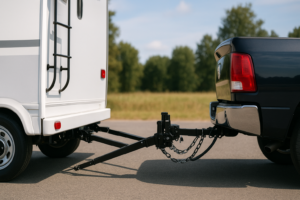
Match your receiver’s weight-carrying rating to your loaded tongue weight, and step up to weight distribution when tongue weight exceeds that rating. Because dump loads shift the balance dramatically between full and empty, choose a tow vehicle with margin so you are not living at the edge of its ratings on every haul. For the mechanics of that, see our guide on weight distribution hitches for dump trailers.
Learn More with TowPro Academy
Matching a truck to a dump trailer is about respecting payload and braking, not just horsepower. For a complete system on capacity, weight, and safe heavy hauling, explore the TowPro Academy towing course. See also our guide to weight distribution hitches for dump trailers and the NHTSA trailer safety resources.
Picking the Right Tow Vehicle for a Dump Trailer: The Bottom Line
The right tow vehicle for a dump trailer is the one that comfortably covers your real loaded weight, not just the trailer’s empty footprint. Get the payload, braking, and hitch setup right, and a dump trailer tows predictably load after load. Get it wrong, and you’re fighting squat, sway, and long stopping distances on every haul.
READY TO STOP GUESSING?
LEARN THE RIGHT WAY. BUILD THE SKILLS TO TOW MORE SAFELY.
Free Download
Never Miss a Safety Check Again
The exact 66-point checklist Jeff runs before every tow, so small problems get caught before they become breakdowns. Enter your email and we will send it over.
Free PDF · Instant download · No spam, unsubscribe any time
Build the skills to tow more safely. 51 video lessons, one-time payment.
ENROLL NOWOne-time payment - 30-Day money-back guarantee
Want the full system for matching trucks and trailers, setting up your hitch, and towing heavy loads with confidence? The TowPro Academy towing course covers vehicle selection, weight distribution, and braking in 51 step-by-step video lessons, for a one-time $79 payment with access for as long as the course is hosted.
Learn It Right the First Time
- 51 video lessons, hitching to backing to emergencies
- 950+ pages of PDF guides and checklists
- Final exam: score 80% to earn your certificate of completion
- 30-day refund if it is not for you
$79 through Oct 31 (regularly $99)
Frequently Asked Questions
What size truck do I need to tow a dump trailer?
It depends on your loaded weight, but because dump loads are dense, many owners need a three-quarter-ton or one-ton truck. Base the decision on your real loaded gross and tongue weight, not the empty trailer.
Is towing capacity or payload more important for a dump trailer?
Payload is usually the limiting factor. Dense dump loads create high tongue weight, which counts against payload and is often exceeded before towing capacity becomes the issue.
Do I need trailer brakes for a dump trailer?
Yes. A loaded dump trailer needs functioning brakes, ideally on every axle, paired with an integrated brake controller in the tow vehicle to stop safely.
Should I use a weight distribution hitch with a dump trailer?
Use one when your loaded tongue weight exceeds the receiver’s weight-carrying rating or the loaded trailer weighs more than about half your tow vehicle.
Is it worth taking a course to choose the right tow vehicle for a dump trailer?
Yes, especially if you’re buying or upgrading a truck. A wrong guess on payload or braking can cost thousands in the wrong truck. The TowPro Academy course walks through matching a tow vehicle for a dump trailer to your real loaded weights before you buy.
Stop guessing. Start towing with confidence.
The TowPro Course walks you through every skill in real road scenarios.
Step-by-step video lessons, a final exam, and printable lesson guides and checklists — everything in one place for $79 (fall special, reg. $99).
Enroll Now — $79 (Fall Special, reg. $99) →RELATED ARTICLES
- ›How to Park a Trailer (and Secure It So It Won’t Roll)
- ›1/2 Ton Truck Towing Capacity: What You Can Really Tow
- ›How to Adjust a Weight Distribution Hitch (Step-by-Step)
- ›How to Back a Trailer Into a Campsite (Even the Blind Side)
Ready to put it all together? Enroll in TowPro Academy and master safe towing in 51 step-by-step lessons.