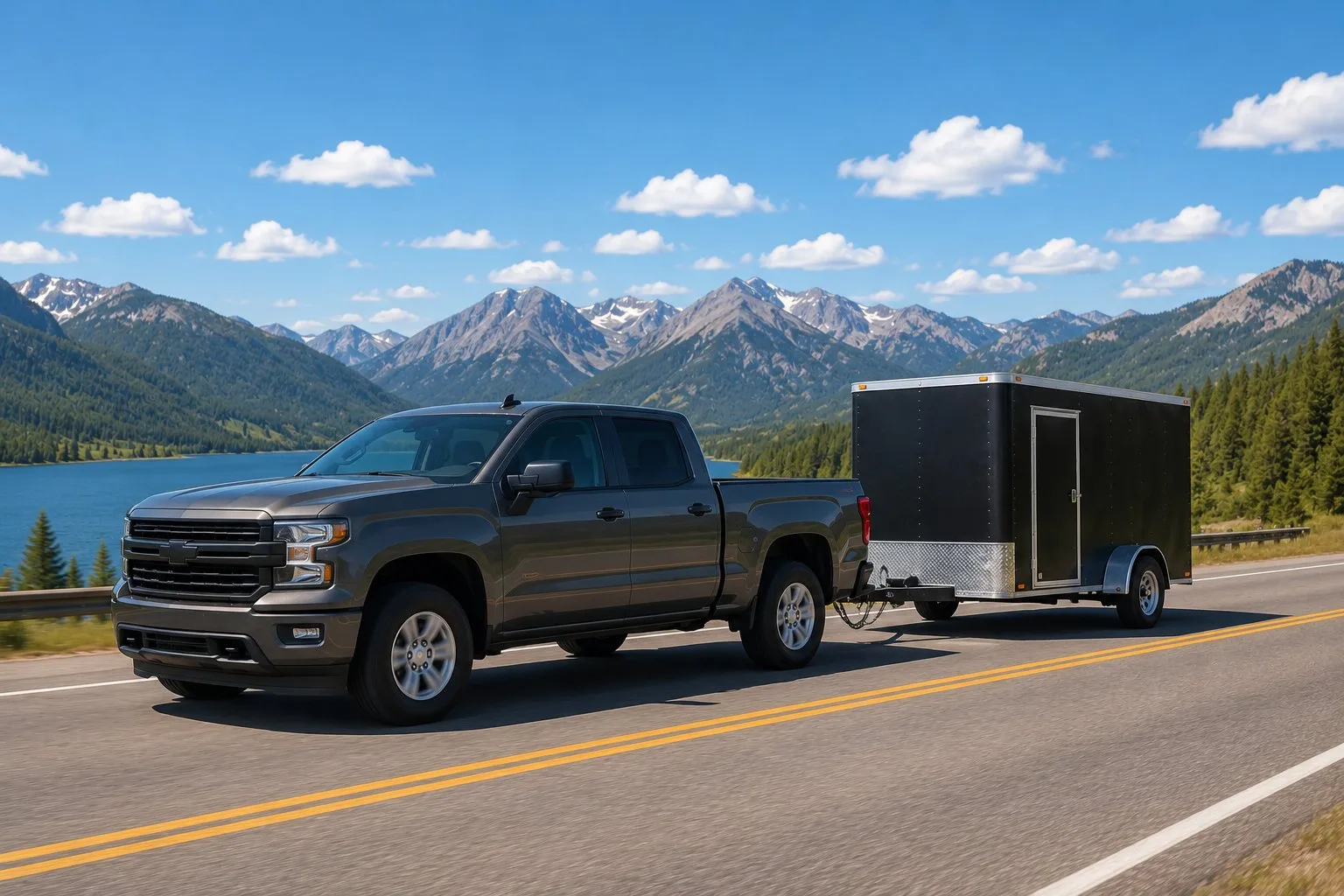
If your trailer is wider than your truck, you legally cannot see behind it with your stock mirrors — and in most states, that means you’re required to use towing mirrors. Even where not required by law, driving blind alongside a wide trailer is genuinely dangerous. Here’s everything you need to know about choosing and using towing mirrors.
Not sure your setup is within limits? Check it in 30 seconds with our free towing capacity calculator.
Want structured, step-by-step training? Check out our online trailer towing course to learn everything you need to tow with confidence.
Why Towing Mirrors Matter
Your truck’s factory side mirrors are designed to show traffic in the lane behind you. They work perfectly for a solo truck. But the moment you attach a trailer that’s wider than your truck — a horse trailer, fifth wheel, enclosed cargo trailer, flatbed, or RV — those mirrors no longer show you what’s alongside the trailer.
Changing lanes becomes dangerous. You have blind spots running the entire length of the trailer. Other drivers can sit in those blind zones for miles without you knowing. Backing up without seeing the sides of your trailer is frustrating at best and a fender-bender at worst.
Towing mirrors extend your mirrors outward and sometimes add a convex wide-angle section at the bottom to see directly alongside the trailer — eliminating those blind spots.
READY TO STOP GUESSING?
LEARN THE RIGHT WAY. BUILD THE SKILLS TO TOW MORE SAFELY.
Build the skills to tow more safely. 51 video lessons, one-time payment.
ENROLL NOWOne-time payment - 30-Day money-back guarantee
Legal Requirements for Towing Mirrors
Most U.S. states require that a driver have an unobstructed view at least 200 feet behind the vehicle. If your trailer is wider than your truck and blocks that view, you’re required to use extended towing mirrors. The specific laws vary by state, but the general rule is: if you can’t see 200 feet back on both sides, you need extended mirrors.
In practice: if you’re towing anything wider than your truck — which includes most enclosed trailers, horse trailers, flatbeds at max load width, and all RVs — assume you need towing mirrors. Getting pulled over without them, especially after an incident, creates serious liability.
Types of Towing Mirrors
Watch a Free Lesson
See how TowPro Academy teaches it step by step. Jeff McDonough, the founder, has 10+ years and 250,000+ miles of towing behind him.
1. Clip-On / Snap-On Towing Mirrors
These clamp directly over your existing side mirrors and extend them outward. They’re inexpensive ($20–$60 per pair), require no tools to install, and can be removed when not towing. The downside: fit varies by truck model, cheaper versions vibrate at highway speed, and they can scratch your stock mirror housing.
Best for: Occasional towers who want a simple, removable option for a specific trailer.
Free Download
Never Miss a Safety Check Again
The exact 66-point checklist Jeff runs before every tow, so small problems get caught before they become breakdowns. Enter your email and we will send it over.
Free PDF · Instant download · No spam, unsubscribe any time
2. Slip-On / Strap-On Towing Mirrors
Similar to clip-ons but use rubber straps around the stock mirror housing instead of clamps. Slightly more secure but still quick to install and remove. Usually $30–$80 per pair.
Best for: Towers who need a temporary, no-modification option.
3. Replacement Towing Mirrors
These bolt directly onto your truck in place of the factory mirrors. They’re the most stable, best-looking option, and many feature power adjustment, heating, and integrated turn signals to match your factory mirror features. Price ranges from $100–$400+ per pair depending on features and truck compatibility.
Best for: Regular towers who want a clean, permanent solution without the hassle of clip-ons.
4. Extendable Towing Mirrors
Many newer trucks (especially full-size pickups) come with factory mirrors that have a towing extension mode — you flip or pull a tab to extend them outward when towing, then retract them for daily driving. If your truck has these, use them every single time you hitch up. Check your owner’s manual.
Best for: Owners of newer F-150, F-250, Ram, or Silverado trucks with this feature already built in.
What to Look for When Buying Towing Mirrors
- Truck-specific fit: Mirrors designed for your exact make, model, and year will fit better, vibrate less, and look cleaner. Universal mirrors often fit loosely.
- Dual glass: Look for mirrors with both a flat glass (for accurate distance behind you) and a convex spot mirror (for wide-angle alongside the trailer). The combination gives full coverage.
- Vibration stability: At 65 mph with a long trailer, mirror vibration makes it impossible to read a license plate. Read reviews specifically for highway vibration before buying.
- Heat and power: If you want heated or power-adjusted replacement mirrors, make sure the aftermarket version retains those functions with your truck’s factory wiring.
- Easy removal: If you want to swap between towing and non-towing configurations, clip-on or strap-on styles need to come off and on quickly without scratching.
How Wide Does Your Trailer Need to Be Before You Need Towing Mirrors?
Here’s a practical field test: stand behind your hitched-up rig and look at the rear. If the trailer sticks out past the outer edge of your truck mirrors on either side, you need towing mirrors. If the trailer is narrower than your truck (common with small utility trailers), your stock mirrors may be sufficient.
Common trailer widths that exceed typical truck width: horse trailers (typically 7–8 feet wide), enclosed cargo trailers (6.5–8.5 feet), fifth wheels and RVs (up to 8.5 feet), and wide-load flatbeds.
Standard full-size truck width: about 6.5–7 feet at the mirrors. Most trailers over 7 feet wide need towing mirrors.
Tips for Using Towing Mirrors Effectively
- Adjust before every trip: Even if your mirrors were set last week, re-check them after hitching up. Tongue weight changes your truck’s ride height and mirror angle.
- Use both the flat and convex sections: Use the flat glass to monitor traffic behind you and judge following distances. Use the convex wide-angle section to check for vehicles alongside your trailer before lane changes.
- Allow extra time for lane changes: Even with good mirrors, always signal early, check twice, and allow extra time when merging with a long trailer. What you see in the mirror happened a second ago — add time for the trailer’s length.
- Back slowly with a spotter when possible: Mirrors help, but a spotter standing where you can see them in the mirror beats trying to interpret reflected angles when backing into a tight space.
Bottom Line
Towing mirrors are not optional for wide trailers — they’re a safety requirement and a legal one in most states. The good news: they’re inexpensive, easy to fit, and dramatically reduce the stress and risk of highway lane changes and backing maneuvers. If you’re pulling anything wider than your truck, get the right mirrors before your next trip. Federal requirements for mirror visibility on towed vehicles are covered in FMCSA 49 CFR §393.80, which specifies the rearward visibility distance requirements that apply when towing wide loads.
TowPro Academy’s towing course covers mirrors, blind spots, backing techniques, and every piece of equipment you need to understand before hooking up. Start learning for $79 — one-time payment, 51 video lessons.
Learn It Right the First Time
- 51 video lessons, hitching to backing to emergencies
- 950+ pages of PDF guides and checklists
- Final exam: score 80% to earn your certificate of completion
- 30-day refund if it is not for you
$79 through Oct 31 (regularly $99)
Frequently Asked Questions About Towing Mirrors
Am I legally required to use towing mirrors?
In most states, yes — if your trailer is wider than your truck and blocks your view more than 200 feet behind you, extended towing mirrors are legally required. Assume you need them for any enclosed trailer, horse trailer, or RV wider than your truck.
What types of towing mirrors are available?
The four main types are clip-on/snap-on mirrors, slip-on/strap-on mirrors, bolt-on replacement mirrors, and factory extendable mirrors built into some newer trucks. Which one fits you best depends on how often you tow and whether you want a permanent or removable solution.
How do I know if my trailer needs towing mirrors?
Stand behind your hitched-up rig and check whether the trailer sticks out past the outer edge of your truck’s mirrors. Most trailers wider than about 7 feet — including most enclosed trailers, horse trailers, and RVs — need towing mirrors, while narrower utility trailers usually don’t.
Are clip-on towing mirrors as good as replacement mirrors?
Clip-on mirrors are a solid, inexpensive option for occasional towing, but replacement mirrors are more stable at highway speed and often include power adjustment and heating. If you tow regularly, replacement mirrors are worth the extra cost.
Good mirrors matter most at highway speed. For step-by-step help with merging, changing lanes and passing, see our guide to towing a trailer on the highway.
Further Reading
- Backing a Trailer with Confidence: Tips and Techniques for Every Driver
- The Pre-Trip Towing Checklist Every Driver Needs
- Towing Capacity Explained: How to Find Your Truck’s Limit and Why It Matters
Read Next
- Pre-Trip Inspection
- Trailer Tire Safety
- Towing Glossary
- New to Towing? Start Here
- Complete Beginner’s Guide to Trailer Towing
Learn to Tow With Confidence
TowPro Academy’s trailer towing course covers towing mirrors, safe lane changes, backing up, and everything else you need to tow safely. 51 lessons for truck owners who tow their own trailers.
Start the Course — $79 One-TimeStop guessing. Start towing with confidence.
The TowPro Course walks you through every skill in real road scenarios.
Step-by-step video lessons, a final exam, and printable lesson guides and checklists — everything in one place for $79 (fall special, reg. $99).
Enroll Now — $79 (Fall Special, reg. $99) →RELATED ARTICLES
- ›Night Towing: Tips and Techniques for Safe After-Dark Driving
- ›How to Buy a Used Trailer: What to Look For Before You Commit
- ›Towing Laws by State: What Every Driver Needs to Know
- ›Trailer Maintenance Schedule: What to Inspect, When, and Why
Ready to put it all together? Enroll in TowPro Academy and master safe towing in 51 step-by-step lessons.