Quick answer: To hitch a trailer, chock its tires, open the coupler latch and raise the coupler above the ball, then back the ball straight under it. Lower the coupler until it seats, close and pin the latch, and do a lift test. Raise the jack fully, cross and hook the safety chains, attach the breakaway cable, plug in the wiring, check every light, test the brakes, and walk around the rig once before you leave.
Hooking up is the one towing job you do on every single trip, and it’s where a small miss can turn into a trailer coming loose on the highway. The good part: hitching isn’t a talent. It’s a routine. If you run the same steps in the same order every time, it becomes automatic, and the mistakes that cause trouble get caught before you roll.
This guide walks through how to hook up a trailer with a standard ball hitch, the setup used on most utility, boat, and small travel trailers. Fifth-wheels and goosenecks use different hardware and aren’t covered here. Want to see each step on screen? Watch the full free lesson, which includes the printable Hitch-Up Checklist.
Know the parts before you start
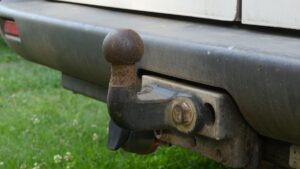
A few names make the steps easier to follow. On the truck, the receiver is the square tube bolted to the frame. The ball mount slides into it and is held by a hitch pin and clip. Always use the clip; without it, the pin can work its way out. The hitch ball bolts to the ball mount.
On the trailer, the coupler fits over the ball, and its latch clamps it in place. Below the tongue hang the safety chains. If the trailer has its own brakes, it will also have a breakaway cable and switch, which applies the trailer brakes if the trailer ever separates from the truck.
Three checks before you ever hook up
- Ball size matches the coupler. The size is usually stamped on the top of the ball and on the coupler. Common sizes are 1-7/8″, 2″, and 2-5/16″. A coupler on a ball that’s too small can look latched and still pop off over a bump. Our trailer ball size guide covers this in detail.
- Every weight rating is high enough. The receiver, ball mount, ball, coupler, chains, and your truck’s towing capacity all have ratings. The lowest one is your real limit.
- The trailer will ride close to level. If the nose points well up or down once hitched, swap to a ball mount with a different drop or rise.
If your trailer has a breakaway system, test the breakaway pin before every trip, then push it straight back in.
How to hitch a trailer, step by step
Watch a Free Lesson
See how TowPro Academy teaches it step by step. Jeff McDonough, the founder, has 10+ years and 250,000+ miles of towing behind him.
1. Chock the trailer and raise the coupler
Put wheel chocks against the trailer’s tires so it can’t move while you work at the tongue. Open the coupler latch, then crank the tongue jack until the coupler sits a little higher than the top of the ball.
READY TO STOP GUESSING?
LEARN THE RIGHT WAY. BUILD THE SKILLS TO TOW MORE SAFELY.
Build the skills to tow more safely. 51 video lessons, one-time payment.
ENROLL NOWOne-time payment - 30-Day money-back guarantee
2. Back the ball under the coupler
Reverse slowly and in a straight line toward the trailer. A backup camera helps, and so does a helper. If you use a helper, agree on hand signals before you move, and stop the moment you lose sight of them. When the ball is directly under the coupler, set the parking brake and shift into Park.
3. Lower the coupler onto the ball
Crank the jack down and watch the coupler settle over the ball. When it takes weight, the back of the truck should squat slightly. If the coupler is resting on top of the ball instead of around it, raise it, reposition, and try again. Never force it down.
4. Close the latch and pin it
Push the latch fully closed, then slide the safety pin or a coupler lock through it. A latch without a pin can open on the road. The simple rule: no pin, no tow.
Free Download
Never Miss a Safety Check Again
The exact 66-point checklist Jeff runs before every tow, so small problems get caught before they become breakdowns. Enter your email and we will send it over.
Free PDF · Instant download · No spam, unsubscribe any time
5. Do the lift test
Crank the jack up a little. If the back of the truck rises with it, the coupler is locked on the ball. If the coupler lifts off the ball instead, it wasn’t seated. Start over from step 3.
6. Raise the jack all the way
Crank the jack fully up. On a swivel jack, rotate it to its travel position and pin it. A jack left down can catch the pavement at the first dip.
7. Cross and hook the safety chains
Cross the chains under the tongue and hook each one to the safety-chain loops on the hitch, never to the bumper or ball mount. The crossed chains form a cradle that catches the tongue if the coupler ever comes off the ball. Leave enough slack to turn, but not so much that they drag, and close any hook keepers.
8. Attach the breakaway cable
If the trailer has brakes, clip the breakaway cable to the attachment point your trailer manual specifies on the truck or hitch. Never clip it to a safety chain: if the trailer separates, the chain goes with it and the pin may never pull. Same slack rule: enough to turn, not enough to drag.
9. Plug in the wiring and check the lights
Push the 4-way flat or 7-way round plug in until it seats, close the cover clip over it, and route the cord so it can flex through turns without dragging. Then check running lights, left turn, right turn, and brake lights. A helper makes this quick. If something doesn’t light up, our trailer light wiring guide can help you track it down.
10. Confirm and test the brakes
With electric brakes, make sure your brake controller shows the trailer as connected. Pull the chocks and stow them in the truck. Then roll forward slowly and squeeze the controller’s manual lever; you should feel the trailer tug back. Need help with gain settings? See the trailer brake controller guide.
11. Walk around, then recheck down the road
Do one full lap of the rig using the checklist below. After the first few miles, pull over somewhere safe and check everything again.
Towing a heavier trailer? Once the coupler is locked, follow our weight distribution hitch setup guide to tension the spring bars and level the truck.
Final walk-around checklist
- Coupler latched and pinned
- Jack fully up (and in travel position)
- Safety chains crossed and hooked to the hitch
- Breakaway cable attached
- Wiring plugged in and all lights working
- Chocks stowed in the truck
- Doors, ramps, and cargo secured
How to unhitch a trailer
Unhooking is roughly the reverse, with one big rule: secure the trailer before you release it.
- Park on the flattest ground available.
- Chock the trailer tires front and back before touching the coupler.
- On soft ground, put a block or pad under the jack foot.
- Unplug the wiring and hang it up off the ground.
- Unclip the breakaway cable without pulling the pin.
- Unhook the safety chains.
- Open the latch and crank the coupler up clear of the ball. Watch the tongue: if the trailer is tail-heavy, put stands under the rear first.
- Pull the truck forward slowly.
Common hitching mistakes (and the five-second fix)
- Wrong ball size. Read the stamps on the ball and coupler before you couple.
- Latch not pinned. Pin or lock it every time.
- Chains not crossed, or hooked to the bumper. Cross them and use the hitch loops.
- Breakaway cable on a safety chain. Attach it where your manual says.
- Jack left down. Crank it up and pin the swivel.
- Skipped light check. Check all four functions before leaving.
Each of these takes seconds to prevent, which is why the checklist matters most on days you’re in a hurry. Brake and breakaway rules vary by state, so check your state’s requirements and follow your owner’s manuals.
Learn It Right the First Time
- 51 video lessons, hitching to backing to emergencies
- 950+ pages of PDF guides and checklists
- Final exam: score 80% to earn your certificate of completion
- 30-day refund if it is not for you
$79 through Oct 31 (regularly $99)
Frequently asked questions
What size hitch ball do I need?
One that matches your coupler. Common sizes are 1-7/8″, 2″, and 2-5/16″, and the size is usually stamped on the ball and the coupler. The ball’s weight rating also has to cover your trailer.
Why do you cross trailer safety chains?
Crossed chains make a cradle under the tongue. If the coupler comes off the ball, the tongue drops into the cradle instead of hitting the pavement.
How do I know the coupler is locked on the ball?
Latch and pin it, then do a lift test: crank the jack up slightly. If the back of the truck rises, it’s locked. If the coupler lifts off the ball, raise it and recouple.
Where does the breakaway cable attach?
To the attachment point on the truck or hitch that your trailer manual specifies, never to a safety chain. Leave enough slack to turn without dragging.
Next: how to park a trailer and secure it.
Stop guessing. Start towing with confidence.
The TowPro Course walks you through every skill in real road scenarios.
Step-by-step video lessons, a final exam, and printable lesson guides and checklists — everything in one place for $79 (fall special, reg. $99).
Enroll Now — $79 (Fall Special, reg. $99) →RELATED ARTICLES
- ›Tow Dolly vs Car Trailer: Which Should You Use?
- ›4-Pin vs 7-Pin Trailer Plug: What’s the Difference?
- ›Trailer Lights Not Working? How to Find and Fix the Problem
- ›Trailer Breakaway Switch: How It Works and How to Test It
Ready to put it all together? Enroll in TowPro Academy and master safe towing in 51 step-by-step lessons.