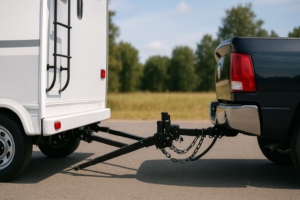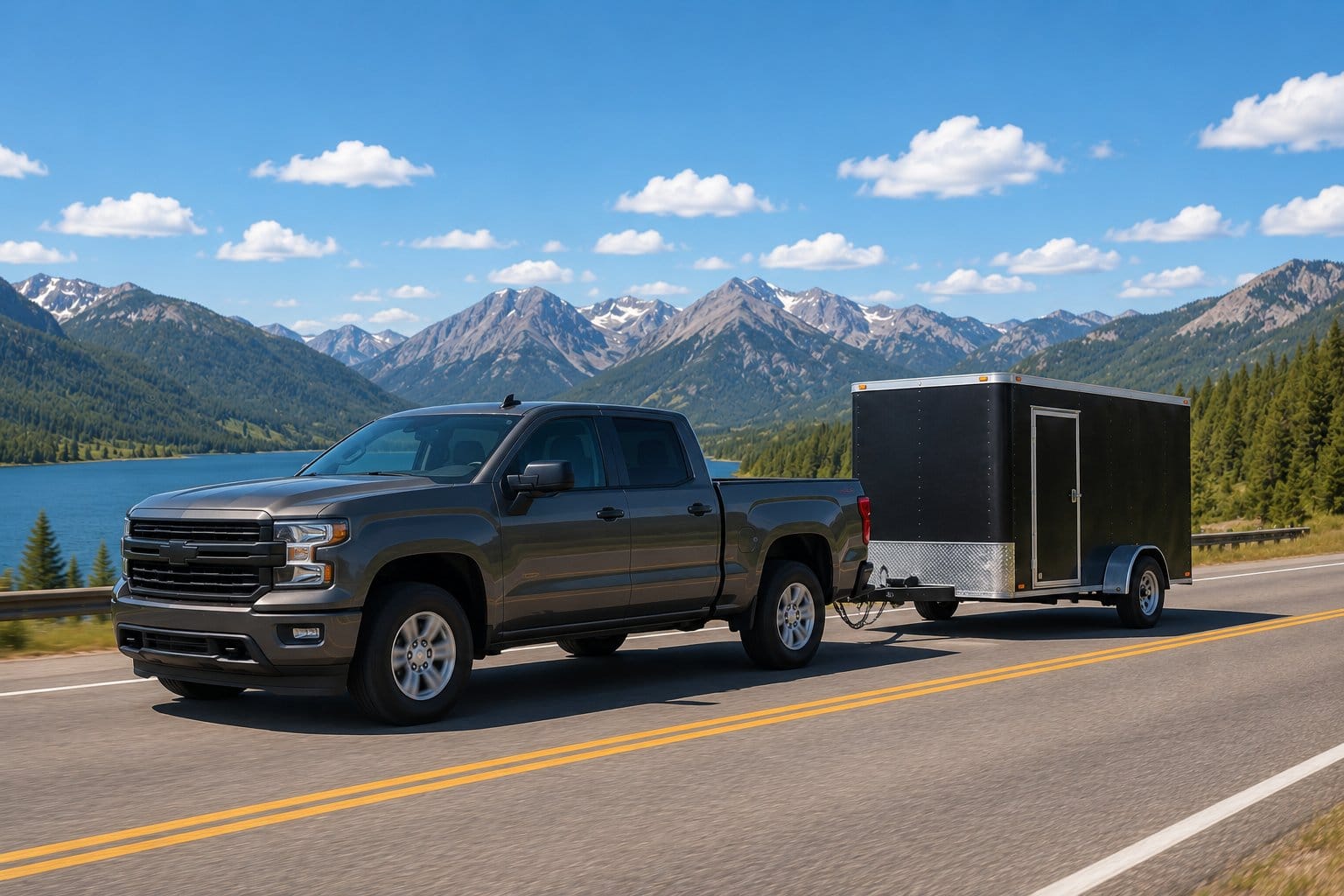
Quick answer: To park a trailer, choose level ground you can pull straight out of, and drive straight for the last stretch so the trailer lines up behind the truck. Set the parking brake, shift into Park, and chock the trailer wheels. On a slope, have the chocks placed on the downhill side of the trailer tires before you shift into Park. If you unhitch, chock the tires front and rear first, and lock the coupler before you walk away.
Parking a trailer isn’t just finding a space big enough. It’s three jobs: picking a spot that works for both parking and leaving, getting the rig straight, and making sure nothing moves once you walk away. Get those right and you’ll avoid the most common parking headaches, from a jackknifed rig you can’t get out of to a trailer that creeps downhill.
This guide covers general parking and securing. For tight curbside spots, see our dedicated guide on how to parallel park a trailer.
Choose the right spot first
The best parking job starts before you turn in. NHTSA advises avoiding parking on grades when you can, so look for level, firm ground. Just as important, look for a spot you can pull straight out of. Leaving forward means you don’t have to back a trailer out into traffic or a busy lot aisle.
- Level and firm: pavement or packed gravel beats soft grass or mud, especially if you plan to unhitch.
- An exit plan: before you commit, picture how you’ll leave. Don’t box yourself in with no way out forward.
- Room to spare: account for the full length of truck and trailer, plus swing room for the trailer’s tail in turns.
- A spotter if possible: someone outside the truck can see what your mirrors can’t.
Pull-through parking: the easy option
Whenever you can, use a pull-through spot: one you drive into forward and leave forward, like a row of end-to-end spaces at a rest area, or two empty spaces in a line at the edge of a lot. Approach so you can drive in on a straight line. Then pull forward in a straight line for the last stretch before you stop. That lets the trailer settle in directly behind the truck.
A straight rig takes up less room, stays inside the lines, and is much easier to drive out of later. Stopping with the rig still bent at an angle is one of the most common parking mistakes, because it often means you have to back up just to get moving again.
Backing into a spot
Watch a Free Lesson
See how TowPro Academy teaches it step by step. Jeff McDonough, the founder, has 10+ years and 250,000+ miles of towing behind him.
Sometimes there’s no pull-through: a campsite, a driveway, or a storage yard. Backing in takes more time up front but sets you up to leave forward. Go slowly and use a spotter, and agree on signals before you move. If your spotter goes out of view in your mirrors, stop.
READY TO STOP GUESSING?
LEARN THE RIGHT WAY. BUILD THE SKILLS TO TOW MORE SAFELY.
Build the skills to tow more safely. 51 video lessons, one-time payment.
ENROLL NOWOne-time payment - 30-Day money-back guarantee
NHTSA’s advice for when it isn’t going well: pull forward, realign the tow vehicle and trailer, and start again. There’s no prize for saving a bad approach. For the steering technique, see how to back up a trailer.
Securing the trailer on level ground
Once you’re stopped on level ground, the order is simple:
- Set the truck’s parking brake.
- Shift into Park (or into gear, per your manual, for a manual transmission).
- Chock the trailer wheels.
Chocks are cheap insurance. Even on flat ground, they keep the trailer from rolling if something gets bumped, and wheel chocks are on NHTSA’s pre-trip checklist for a reason. Keep a pair in the truck every time you tow.
Free Download
Never Miss a Safety Check Again
The exact 66-point checklist Jeff runs before every tow, so small problems get caught before they become breakdowns. Enter your email and we will send it over.
Free PDF · Instant download · No spam, unsubscribe any time
Parking a trailer on a slope
If you can’t avoid a grade, the order of steps matters. NHTSA’s guidance:
- Once stopped, but before shifting into Park, keep your foot on the brake and have someone place chocks on the downhill side of the trailer wheels.
- Apply the parking brake.
- Shift into Park.
- Take your foot off the brake.
Why that order? According to NHTSA, it keeps your vehicle from getting locked in Park because of extra load on the transmission. Letting the chocks take the trailer’s weight, instead of the parking pawl, makes it easier to shift out later.
Ford’s towing guide orders it slightly differently: once the chocks are in, release the brake pedal and make sure the chocks hold, then set the parking brake and shift into Park. Both approaches put the chocks in before the transmission takes the load. Your owner’s manual has the exact steps for your vehicle, so follow it. For driving on hills, see towing uphill and downhill safely.
Leaving a slope
Ford’s guide covers the exit too: hold the brake and start the engine with the shifter in Park. Shift into gear and release the parking brake. Release the brake pedal and move uphill just enough to free the chocks. Then hold the brake while someone else picks up the chocks.
Leaving it hitched vs. unhitched
Leaving it hitched is fine for a short stop, like a meal or fuel break. The truck’s parking brake and transmission hold the rig, and the chocks back them up. You also keep a quick getaway.
Unhitching makes sense when you’re staying a while, at a campsite or in storage. Do it in this order:
- Chock front and rear first. NHTSA says to place blocks at the front and rear of the trailer tires before you release the coupler, so the trailer can’t roll away once the truck isn’t holding it.
- Put a pad under the tongue jack. On soft ground, a block or jack pad under the jack foot spreads the load so it doesn’t sink.
- Watch the balance. An unbalanced load can make the tongue tip up. If the trailer is tail-heavy, put jack stands under the rear before you uncouple.
A trailer with its own brakes doesn’t have a parking brake you can rely on once it’s unhitched, so the chocks are what hold it. Don’t treat the breakaway pin as a parking brake.
Security: hitch locks and wheel locks
Securing a trailer also means making it hard to steal. The lesson’s rule is simple: lock your coupler if you leave the trailer.
- Coupler lock: for an unhitched trailer, a lock that fills or covers the coupler keeps someone from dropping it onto their own ball.
- Hitch pin lock: while hitched, a locking hitch pin keeps the ball mount in your receiver, and a lock through the coupler latch keeps the trailer on the ball.
- Wheel lock or boot: a wheel lock makes the trailer hard to roll away even if the coupler is defeated. It’s worth it for long-term storage.
Where you park matters
Be a good neighbor. Don’t block driveways, lanes, or anyone else’s way out. Some lots and streets limit trailer parking, so check the signs and local rules before you leave a rig for any length of time.
Common trailer parking mistakes
- Parking on a slope when there’s a level spot nearby.
- Stopping with the rig still bent.
- Shifting into Park before chocking on a grade.
- Unhitching without chocks.
- Boxing yourself in with no way out forward.
Recap: pick a level spot you can pull out of forward, drive straight for the last stretch, then parking brake, Park, chocks. On a grade, chocks go on the downhill side before you shift into Park. Before you unhitch, chock front and rear.
Learn It Right the First Time
- 51 video lessons, hitching to backing to emergencies
- 950+ pages of PDF guides and checklists
- Final exam: score 80% to earn your certificate of completion
- 30-day refund if it is not for you
$79 through Oct 31 (regularly $99)
Frequently asked questions
Which side of the wheels do chocks go on when parking on a hill?
The downhill side of the trailer wheels, so they block the direction the trailer would roll. Place them before you shift into Park.
Should I set the parking brake or shift into Park first?
On level ground, set the parking brake, shift into Park, then chock. On a grade, chock first, then follow your owner’s manual; NHTSA and Ford both put the chocks in before the transmission takes the load.
Is it OK to leave a trailer hitched to the truck overnight?
It can be, on level ground with the parking brake set, the truck in Park, the trailer chocked, and the coupler and hitch pin locked. Check that local rules allow it where you’re parked.
How do I keep an unhitched trailer from rolling?
Chock the tires front and rear before you release the coupler, park on level ground, put a pad under the jack foot on soft ground, and use jack stands at the rear if the load is tail-heavy.
Before you park, make sure you hitched it correctly.
Stop guessing. Start towing with confidence.
The TowPro Course walks you through every skill in real road scenarios.
Step-by-step video lessons, a final exam, and printable lesson guides and checklists — everything in one place for $79 (fall special, reg. $99).
Enroll Now — $79 (Fall Special, reg. $99) →RELATED ARTICLES
- ›1/2 Ton Truck Towing Capacity: What You Can Really Tow
- ›How to Adjust a Weight Distribution Hitch (Step-by-Step)
- ›How to Back a Trailer Into a Campsite (Even the Blind Side)
- ›Learn to Tow a Trailer With Confidence: The TowPro Academy Online Towing Course
Ready to put it all together? Enroll in TowPro Academy and master safe towing in 51 step-by-step lessons.