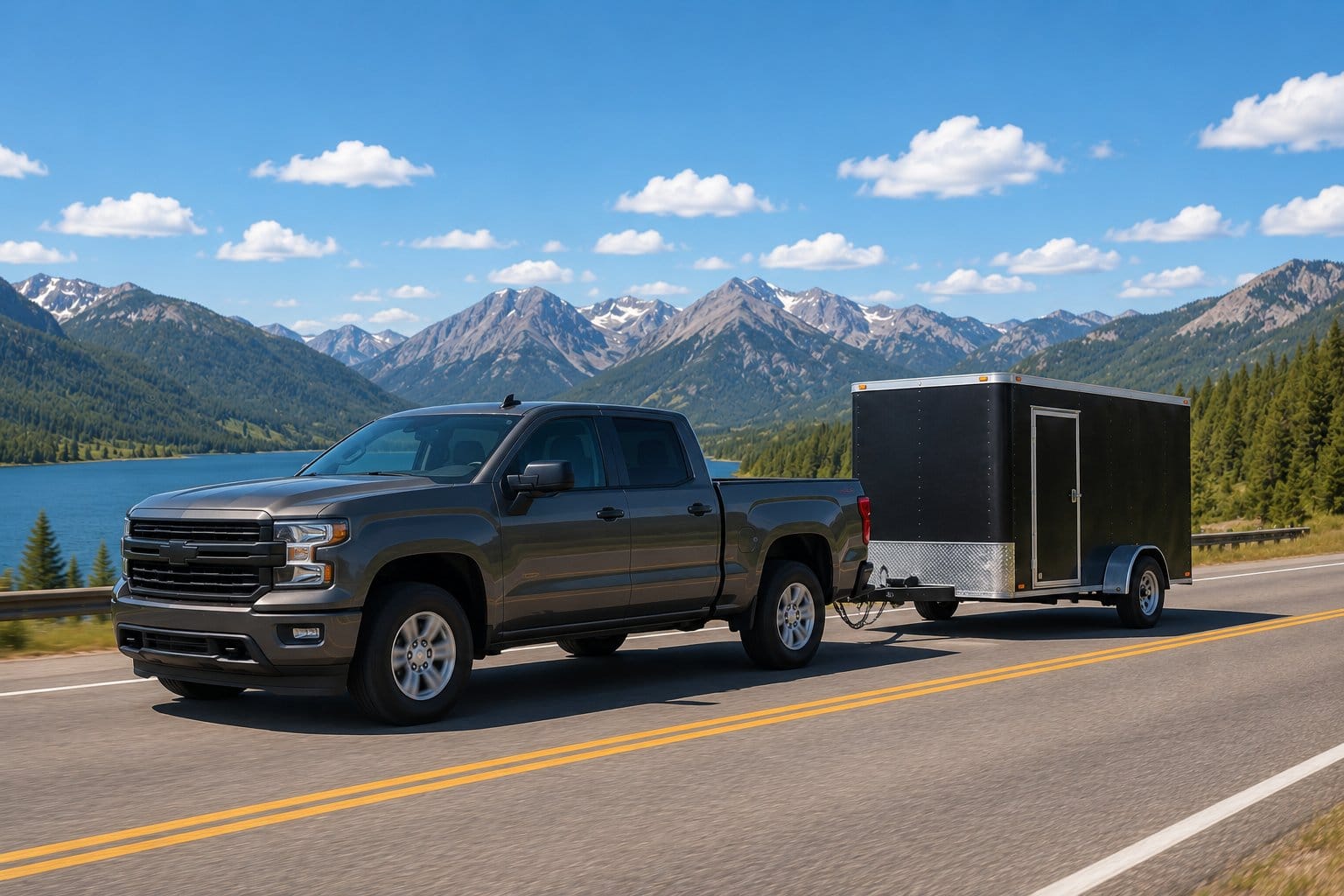
Short answer: a 4-pin plug runs only the trailer’s lights (running lights, left turn/brake, right turn/brake and ground). A 7-pin plug adds electric brakes, a 12-volt power line and usually reverse lights. If your trailer has electric brakes, you need a 7-pin connection and a brake controller in the tow vehicle. If it only has lights, a 4-pin is all you need.
Trailer plugs look confusing until you know what each pin does. Here’s a plain-English breakdown of the common connector types, how to tell which one your trailer needs, and what to do when your truck and trailer don’t match.
What Each Trailer Plug Does
Every trailer connector has the same basic job: send power from the tow vehicle to the trailer’s lights, and on bigger trailers, to its brakes and accessories. The difference between connector types is how many separate circuits they carry.
4-Pin Flat Connector
The 4-pin flat plug is the most common connector on small utility trailers, boat trailers, jet ski trailers and many small campers without electric brakes. It carries four circuits:
- Ground (usually the white wire)
- Tail and running lights (usually brown)
- Left turn signal and brake light (usually yellow)
- Right turn signal and brake light (usually green)
That’s it: no brake power, no charge line, no reverse lights. It’s simple, cheap and easy to find adapters for.
5-Pin Flat Connector
A 5-pin flat plug is a 4-pin with one extra wire. That fifth wire is most often used on boat trailers with surge brakes: it’s tied to the tow vehicle’s reverse lights and powers a solenoid that keeps the surge brakes from locking up when you back up. Not every surge-brake trailer uses one, so check your trailer’s brake setup.
6-Pin Round Connector
The 6-pin round plug shows up on some older trailers, horse trailers and farm equipment. It adds two circuits to the basic four, typically an electric brake line and a 12-volt power line. You’ll see it less often today, since most trucks with factory tow packages come with a 7-pin.
READY TO STOP GUESSING?
LEARN THE RIGHT WAY. BUILD THE SKILLS TO TOW MORE SAFELY.
Build the skills to tow more safely. 51 video lessons, one-time payment.
ENROLL NOWOne-time payment - 30-Day money-back guarantee
7-Pin RV Blade Connector
The 7-pin round blade connector is the standard for travel trailers, fifth wheels, larger cargo trailers and most trailers with electric brakes. On top of the four lighting circuits, it typically carries:
Free Download
Never Miss a Safety Check Again
The exact 66-point checklist Jeff runs before every tow, so small problems get caught before they become breakdowns. Enter your email and we will send it over.
Free PDF · Instant download · No spam, unsubscribe any time
- Electric brake signal from the brake controller
- 12-volt power, which can charge the trailer battery and power accessories
- Reverse lights (or an auxiliary circuit)
Wire colors on 7-pin connectors aren’t as consistent as on 4-pin plugs, so always check the wiring diagram from your trailer or connector manufacturer before you splice anything.
4-Pin vs 7-Pin: Which Do You Need?
It comes down to what’s on your trailer:
- Lights only, no brakes: a 4-pin is fine. Most small utility, boat and personal watercraft trailers fall here.
- Surge brakes: usually a 4-pin or 5-pin, since surge brakes work off the trailer’s own momentum, not an electric signal. Our surge brakes vs electric brakes guide explains the difference.
- Electric brakes: you need a 7-pin (or a 6-pin on some older setups) plus a working trailer brake controller in the tow vehicle.
- A trailer battery you want to charge while driving: you need the 12-volt line, so a 7-pin.
Many states require brakes on trailers above a certain weight, so heavier trailers usually end up on a 7-pin. Check the trailer brake requirements by state to see where your trailer falls.
How to Tell What Your Truck Has
Watch a Free Lesson
See how TowPro Academy teaches it step by step. Jeff McDonough, the founder, has 10+ years and 250,000+ miles of towing behind him.
Look near the receiver hitch, often on the bumper or just under it. Many trucks with a factory tow package have a 7-pin round socket and a 4-pin flat connector side by side. Some vehicles only have a 4-pin, and some have no connector at all and need a wiring harness installed. Your owner’s manual will also tell you what came from the factory.
What If Your Truck and Trailer Don’t Match?
7-pin truck, 4-pin trailer: this is the easy one. A 7-to-4 adapter plugs into the truck’s 7-pin socket and gives you a 4-pin flat outlet. Your lights will work normally. Plenty of truck owners keep one in the glove box.
4-pin truck, 7-pin trailer: a 4-to-7 adapter will make the trailer’s lights work, but it can’t power electric brakes, because the truck isn’t sending a brake signal. If your trailer has electric brakes, you need a brake controller and the wiring to support it, not just an adapter. Towing a trailer with electric brakes that aren’t connected means you’re stopping the whole load with the truck’s brakes alone.
Quick Connector Checks Before Every Trip
- Look inside the plug and socket. Corrosion, bent pins or packed dirt cause most flickering and dead lights.
- Plug in fully and seat the latch. A half-seated plug can pop loose on a bump.
- Leave a little slack in the cord. It should flex through tight turns without pulling tight or dragging on the road.
- Test every light with a helper: running lights, both turn signals, brake lights and reverse lights if you have them.
- Check the brakes at low speed. With a 7-pin and electric brakes, squeeze the manual lever on your brake controller while rolling slowly to confirm the trailer brakes grab.
- Hook up the breakaway cable separately. If you have electric brakes, the breakaway switch cable clips to the tow vehicle on its own, not to the plug or a safety chain.
If something still isn’t working, our trailer lights not working troubleshooting guide walks through the usual causes, and how to wire trailer lights covers rewiring from scratch.
TowPro Academy was built by Jeff McDonough, founder of TowPro Academy, who has 10+ years and more than 250,000 miles of towing experience. If you want to learn hitching, wiring checks, braking and backing step by step, start with the free lesson or enroll in the full course.
Learn It Right the First Time
- 51 video lessons, hitching to backing to emergencies
- 950+ pages of PDF guides and checklists
- Final exam: score 80% to earn your certificate of completion
- 30-day refund if it is not for you
$79 through Oct 31 (regularly $99)
Frequently Asked Questions
Can I use a 4-pin plug on a trailer with electric brakes?
Not for the brakes. A 4-pin plug has no brake circuit, so the lights will work but the electric brakes won’t. You need a 7-pin connection and a brake controller.
Can I plug a 4-pin trailer into a 7-pin truck?
Yes, with a 7-to-4 adapter. It’s one of the most common and cheapest towing accessories, and the lights will work normally.
What does the center pin on a 7-pin connector do?
On most 7-pin RV blade connectors it’s used for reverse lights or an auxiliary circuit, but layouts can vary. Check your vehicle and trailer wiring diagrams to be sure.
Why do my trailer lights flicker?
Most often it’s a bad ground or a corroded plug. Clean the pins and socket, check the white ground wire’s connection to the trailer frame, and make sure the plug is fully seated.
Stop guessing. Start towing with confidence.
The TowPro Course walks you through every skill in real road scenarios.
Step-by-step video lessons, a final exam, and printable lesson guides and checklists — everything in one place for $79 (fall special, reg. $99).
Enroll Now — $79 (Fall Special, reg. $99) →RELATED ARTICLES
- ›Tow Dolly vs Car Trailer: Which Should You Use?
- ›Trailer Lights Not Working? How to Find and Fix the Problem
- ›Trailer Breakaway Switch: How It Works and How to Test It
- ›How to Hook Up Trailer Safety Chains the Right Way
Ready to put it all together? Enroll in TowPro Academy and master safe towing in 51 step-by-step lessons.