Selecting the Right Tow Vehicle for Your Travel Trailer
Selecting the right tow vehicle for your travel trailer is the most important decision you will make as a tower, because everything else depends on having enough capability with a margin to spare. The right vehicle tows your loaded trailer safely and comfortably; the wrong one strains the drivetrain, brakes poorly, and handles unpredictably. This guide walks you through towing capacity, payload, vehicle types, and the equipment that ties it all together.
Want to check your own setup? Plug your numbers into our free towing capacity calculator to see how your truck and trailer match up.
Understanding Towing Capacity
Towing capacity is the maximum weight a vehicle can safely pull, and it is the first number to check. Never plan to tow at the limit; aim for your loaded trailer to sit at roughly 80% of the rated capacity so you have margin for hills, wind, and cargo. Always confirm the figure in your owner’s manual rather than relying on marketing numbers. Our guide on reading your truck’s towing specs shows you where to find it.
Payload Capacity Considerations
Watch a Free Lesson
See how TowPro Academy teaches it step by step. Jeff McDonough, the founder, has 10+ years and 250,000+ miles of towing behind him.
Payload capacity is just as important as towing capacity and is more often exceeded. Payload is everything the vehicle carries: passengers, cargo, and the trailer’s tongue weight pressing down on the hitch. A truck can have a huge tow rating yet run out of payload once you add a family and a heavy tongue weight, so check both numbers together.
Types of Tow Vehicle for Your Travel Trailer
Different vehicles suit different trailers:
SUVs
Midsize and full-size SUVs comfortably tow small to midsize travel trailers and offer enclosed passenger space. Confirm the specific trim and towing package, since ratings vary widely within the same model.
Pickup Trucks
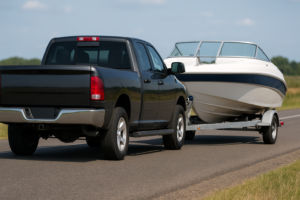
Half-ton, three-quarter-ton, and one-ton pickups are the most capable and flexible tow vehicles, handling everything from light trailers to large fifth wheels. They typically offer higher payload, which matters most for heavier trailers.
READY TO STOP GUESSING?
LEARN THE RIGHT WAY. BUILD THE SKILLS TO TOW MORE SAFELY.
Build the skills to tow more safely. 51 video lessons, one-time payment.
ENROLL NOWOne-time payment - 30-Day money-back guarantee
Free Download
Never Miss a Safety Check Again
The exact 66-point checklist Jeff runs before every tow, so small problems get caught before they become breakdowns. Enter your email and we will send it over.
Free PDF · Instant download · No spam, unsubscribe any time
Vans
Full-size vans provide strong towing capacity plus generous interior room, making them a practical option for larger families hauling midsize trailers.
Considering Hitch and Equipment Needs
The right hitch and equipment complete the setup. Heavier travel trailers usually need a weight distribution hitch with sway control to tow safely and keep the rig level. Confirm your hitch’s weight-carrying and weight-distributing ratings match your trailer, and see our guide on weight distribution and sway control.
Engine and Transmission Factors
Torque, gearing, and cooling matter as much as raw horsepower for towing. Look for a vehicle with a towing package that adds a transmission cooler and often heavier-duty components, since heat is the enemy of the drivetrain when pulling a load up grades.
Additional Safety Considerations
Prioritize a strong braking system, an integrated trailer brake controller, and towing mirrors for visibility. Modern towing aids like trailer sway control and blind-spot monitoring add real safety margin. The NHTSA trailer safety resources reinforce staying within your vehicle’s rated limits.
Learn More with TowPro Academy
Matching your vehicle to your trailer is the foundation of safe towing. For a complete, step-by-step system covering vehicle selection, hitching, and control, explore the TowPro Academy towing course and tow with more confidence.
If you’re curious why I built TowPro Academy, here’s the story from me as the founder.
Learn It Right the First Time
- 51 video lessons, hitching to backing to emergencies
- 950+ pages of PDF guides and checklists
- Final exam: score 80% to earn your certificate of completion
- 30-day refund if it is not for you
$79 through Oct 31 (regularly $99)
Frequently Asked Questions
How do I know if my vehicle can tow my travel trailer?
Compare your loaded trailer weight to your vehicle’s towing capacity and check that the trailer’s tongue weight plus passengers and cargo stays within payload. Aim to tow at about 80% of the rated capacity for a safety margin.
Is towing capacity or payload more important?
Both matter, but payload is more often exceeded. A vehicle can have a high tow rating yet run out of payload once you add passengers, cargo, and tongue weight, so always check the two together.
What is the best type of vehicle for towing a travel trailer?
Pickup trucks are the most capable and flexible, but midsize and full-size SUVs and vans work well for small to midsize trailers. Choose based on your specific trailer weight and how many people you carry.
Do I need a weight distribution hitch?
Heavier travel trailers usually need a weight distribution hitch with sway control to tow level and safely, especially when tongue weight exceeds your hitch’s weight-carrying rating.
Stop guessing. Start towing with confidence.
The TowPro Course walks you through every skill in real road scenarios.
Step-by-step video lessons, a final exam, and printable lesson guides and checklists — everything in one place for $79 (fall special, reg. $99).
Enroll Now — $79 (Fall Special, reg. $99) →RELATED ARTICLES
- ›How to Park a Trailer (and Secure It So It Won’t Roll)
- ›1/2 Ton Truck Towing Capacity: What You Can Really Tow
- ›How to Adjust a Weight Distribution Hitch (Step-by-Step)
- ›How to Back a Trailer Into a Campsite (Even the Blind Side)
Ready to put it all together? Enroll in TowPro Academy and master safe towing in 51 step-by-step lessons.