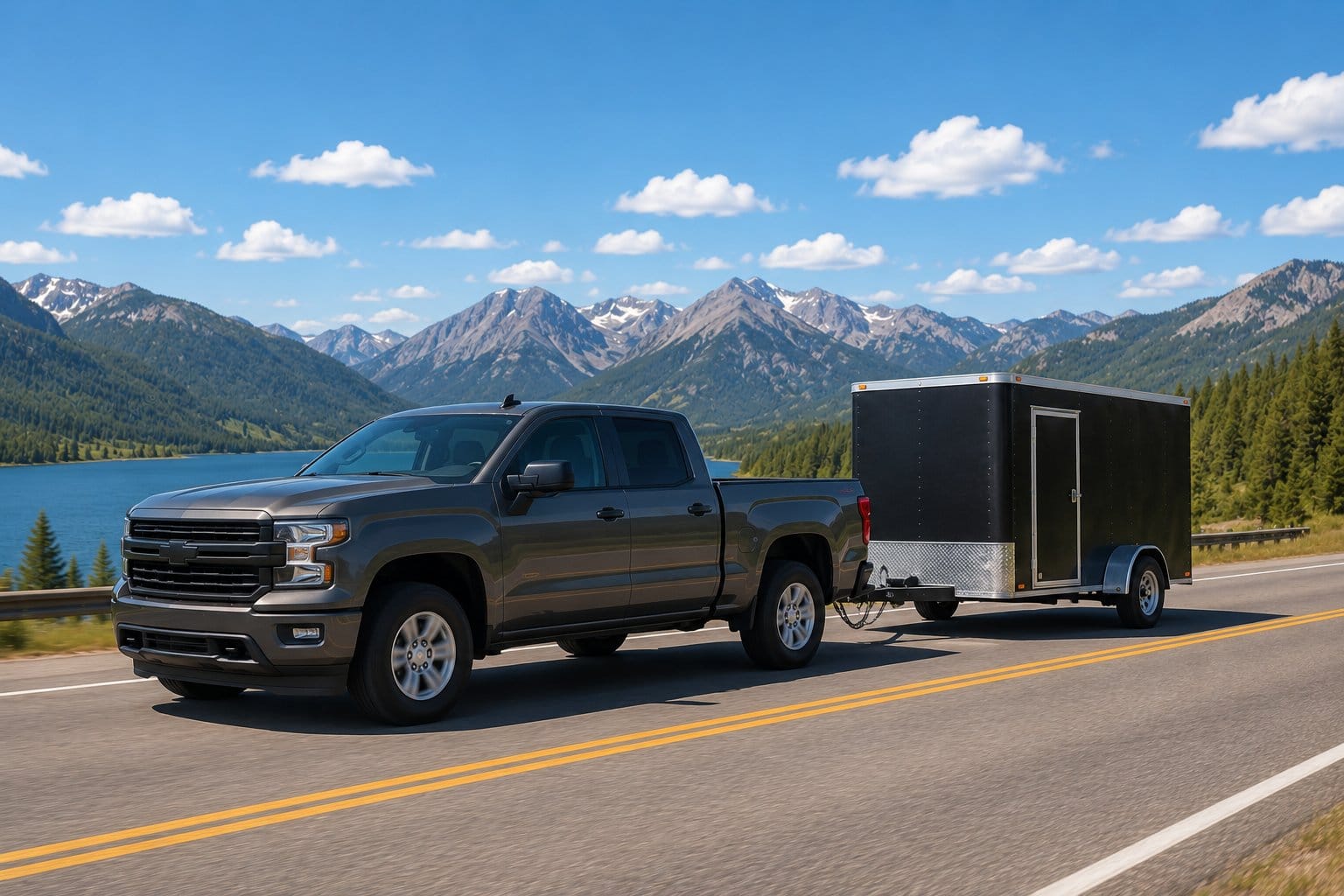
Understanding your truck’s towing capacity is the single most important step before you ever hook up a trailer. Exceed it and you’re risking brake failure, structural damage, and losing control at highway speeds. This guide breaks down every number you need to know — and exactly where to find them.
Want to check your own setup? Plug your numbers into our free towing capacity calculator to see towing capacity, payload, GVWR and GCWR side by side.
TowPro Academy Course
Stop Guessing. Start Towing Right.
51 video lessons • 950+ pages of downloadable lesson guides • 6 modules • 30-day money-back guarantee. Jeff covers every topic in this article and more — step by step, on video.
Enroll Now — $79 through Oct 31 (regularly $99)Access for as long as the course is hosted • No subscriptionTable of Contents
What Is Towing Capacity?
Towing capacity is the maximum weight your vehicle is rated to pull behind it. But here’s what most people miss: that single number doesn’t tell the whole story. There are actually four separate ratings you need to check before hitching up, and they all matter.
The 4 Numbers That Actually Determine What You Can Tow
1. Gross Vehicle Weight Rating (GVWR)
This is the maximum allowable weight of your truck itself — including the vehicle, passengers, fuel, cargo, and tongue weight of the trailer. You’ll find this on a sticker inside the driver’s door jamb. Exceeding your GVWR is illegal and dangerous.
2. Gross Combined Weight Rating (GCWR)
This is the maximum combined weight of your tow vehicle AND the fully loaded trailer. This is often the most overlooked number. You might be within your towing capacity but still exceed your GCWR if your truck is loaded with passengers and gear. GCWR is listed in your owner’s manual — not on the door sticker.
READY TO STOP GUESSING?
LEARN THE RIGHT WAY. BUILD THE SKILLS TO TOW MORE SAFELY.
Build the skills to tow more safely. 51 video lessons, one-time payment.
ENROLL NOWOne-time payment - 30-Day money-back guarantee
3. Payload Capacity
Payload capacity is how much weight your truck can carry in the cab and bed — and it directly affects how much you can tow. Every pound of passengers, tools, and cargo in your truck reduces your available payload. Tongue weight (the downward force the trailer puts on your hitch) counts against payload too. A typical half-ton truck might have 1,500–2,000 lbs of payload, but by the time you add passengers and gear, you may have far less left for tongue weight.
4. Tongue Weight Limit
Tongue weight is the downward force that the front of the trailer exerts on your hitch ball. The rule of thumb is that tongue weight should be 10–15% of the trailer’s total loaded weight. Too little tongue weight causes trailer sway. Too much overloads your rear axle and reduces front-axle steering control. Your hitch has its own tongue weight rating — make sure it matches or exceeds what you need.
How to Find Your Towing Capacity
There are three reliable ways to find your truck’s actual towing capacity. Don’t just Google “how much can a [truck model] tow” — that gives you the maximum possible for any configuration of that truck, which likely isn’t your specific truck.
Method 1: Owner’s Manual
Your owner’s manual has a towing capacity chart specific to your engine, transmission, axle ratio, and whether you have the tow package. This is the most reliable source. Look for the section titled “Trailer Towing” or “Towing and Hauling.” The chart will list different configurations — make sure you’re reading the row that matches your exact setup.
Method 2: Door Jamb Sticker
The sticker inside your driver’s door jamb lists your GVWR, GAWR (Gross Axle Weight Rating), and your vehicle’s curb weight. While it doesn’t always list towing capacity directly, it gives you the GVWR you need to calculate how much tongue weight your truck can handle.
Free Download
Never Miss a Safety Check Again
The exact 66-point checklist Jeff runs before every tow, so small problems get caught before they become breakdowns. Enter your email and we will send it over.
Free PDF · Instant download · No spam, unsubscribe any time
Method 3: VIN Decoder or Manufacturer’s Tow Guide
Most major truck manufacturers (Ford, GM, Ram, Toyota) publish detailed annual towing guides you can download for free. Enter your VIN on the manufacturer’s website to get specs specific to your build — including axle ratio and optional tow packages that affect your rating. This is especially useful for used trucks where you’re not sure of the original configuration.
The Tow Package: Why It Matters
Watch a Free Lesson
See how TowPro Academy teaches it step by step. Jeff McDonough, the founder, has 10+ years and 250,000+ miles of towing behind him.
Most trucks offer an optional factory tow package that increases towing capacity significantly. A tow package typically includes a higher-capacity alternator, transmission cooler, engine oil cooler, upgraded wiring harness, integrated trailer brake controller, and a Class IV or V hitch receiver. Without the tow package, your truck’s maximum towing capacity may be 2,000–5,000 lbs lower than the advertised maximum for that model. Always check whether your specific truck has the tow package before relying on the advertised maximum.
Common Towing Capacity Mistakes
Mistake 1: Using the Trailer’s Dry Weight Instead of Loaded Weight
Trailers are almost never used empty. A travel trailer rated at 6,000 lbs dry might weigh 9,000+ lbs when loaded with fresh water, gear, food, and personal belongings. Always calculate based on the actual loaded weight of your trailer — not the spec sheet dry weight.
Mistake 2: Ignoring Altitude and Grades
Your engine loses power at altitude and under load on steep grades. A truck that comfortably tows 10,000 lbs on flat highway may struggle significantly in mountain terrain. Many manufacturers publish “mountain” towing ratings that are lower than the standard rating. If you regularly tow in hilly or mountainous terrain, build in a significant safety margin.
Mistake 3: Assuming All Hitches Are Equal
Your hitch receiver has its own weight capacity rating, separate from your truck’s towing capacity. A Class III hitch typically handles up to 8,000 lbs GTW (Gross Trailer Weight) and 800 lbs tongue weight. A Class V hitch can handle up to 20,000 lbs. Using a hitch rated below your trailer’s weight is a serious safety hazard — even if your truck can handle the load.
Mistake 4: Forgetting the Weight Distribution Hitch
For trailers over 5,000 lbs or with tongue weight exceeding 10% of your truck’s payload, a weight distribution hitch is often required. It redistributes tongue weight across all axles of both the truck and trailer, improving steering response, braking, and stability. Skipping a weight distribution hitch when towing heavy can void your warranty and seriously compromise safety.
How to Calculate Whether You’re Safe to Tow
Here’s a quick framework to check before every tow:
- Find your truck’s towing capacity (owner’s manual, matched to your exact configuration)
- Weigh your loaded trailer — use a certified scale at a truck stop or weigh station
- Confirm loaded trailer weight is below towing capacity
- Calculate tongue weight — should be 10–15% of loaded trailer weight
- Subtract tongue weight from your payload capacity — add in the weight of all passengers and cargo in the truck
- Confirm the total doesn’t exceed GVWR or GCWR
This sounds like a lot of math, but once you’ve done it once for your specific rig, you’ll know your numbers cold.
Real-World Towing Capacity Examples
Here’s how towing capacity plays out in practical scenarios:
- F-150 with 5.0L V8 and Max Tow Package: Up to 13,000 lbs towing capacity — but payload may limit you to 1,700–2,000 lbs of tongue weight
- RAM 1500 with 5.7L HEMI and tow package: Up to 12,750 lbs — strong for a half-ton but still requires watching payload carefully
- Chevy Silverado 2500HD with 6.6L Duramax: Up to 18,500 lbs — heavy-duty trucks have dramatically more headroom, but they also pull heavier trailers
- Toyota Tundra with 3.5L V6 twin-turbo: Up to 12,000 lbs — competitive with domestic half-tons when properly equipped
When in Doubt, Weigh It Out
The only way to know exactly what your loaded trailer actually weighs is to put it on a scale. Truck stops with CAT scales charge a few dollars and give you a certified weight ticket. Weigh your entire rig (truck + loaded trailer), then weigh just the truck — the difference is your trailer’s loaded weight. You can also use an axle-by-axle reading to calculate tongue weight directly.
Towing within your vehicle’s ratings isn’t just about following rules — it’s about keeping yourself, your passengers, and everyone else on the road safe. The extra five minutes it takes to check your numbers before a trip is one of the most valuable habits you can build as a tower. For official manufacturer towing capacity data specific to your vehicle, major truck brands publish free annual towing guides — Ford’s towing capacity guide is a good example of the vehicle-specific information you should be referencing.
Ready to get confident with every aspect of towing? TowPro Academy’s truck towing course covers towing capacity, hitch setup, weight distribution, backing up, and everything else you need — 51 video lessons for a one-time payment of $79.
Learn It Right the First Time
- 51 video lessons, hitching to backing to emergencies
- 950+ pages of PDF guides and checklists
- Final exam: score 80% to earn your certificate of completion
- 30-day refund if it is not for you
$79 through Oct 31 (regularly $99)
Frequently Asked Questions About Towing Capacity
Can I tow more than my rated capacity for a short trip?
No. Towing capacity ratings are not guidelines — they are engineering limits. Exceeding your towing capacity, even briefly, puts stress on your frame, hitch, brakes, and drivetrain that can cause failures during the trip, not just after. A towing capacity rating is the maximum safe load for your vehicle under ideal conditions. Real-world driving is rarely ideal.
Does towing reduce my fuel economy?
Yes, significantly. Most trucks see a 30–50% reduction in fuel economy while towing at or near capacity. Budget accordingly for longer trips — fuel costs while towing can easily double compared to driving solo. Driving slower (55 mph vs. 70+ mph) reduces fuel consumption meaningfully while towing.
What is the difference between towing capacity and payload capacity?
Towing capacity is how much weight the vehicle can pull behind it. Payload capacity is how much weight the vehicle can carry in the cab and bed. Both matter when towing, because tongue weight (the downward force of the trailer on your hitch) counts against your payload. You can be within your towing capacity but still exceed your payload if you have too many passengers, too much gear in the truck, or too high a tongue weight.
Further Reading
- Trailer Sway Control: Why It Happens and How to Stop It
- The Pre-Trip Towing Checklist Every Driver Needs
- First-Time Towing: What Nobody Tells You (But Should)
How do I find my truck's towing capacity?
The most accurate source is the sticker inside your driver's door jamb, which lists your specific truck's GVWR, GAWR, and maximum trailer weight for your exact configuration. You can also check your owner's manual towing guide section. Avoid relying on general online specs, as towing capacity varies significantly based on engine, axle ratio, cab style, and tow package.
What is the difference between towing capacity and payload capacity?
Towing capacity is the maximum weight your truck can pull behind it on a hitch. Payload capacity is the maximum weight your truck can carry in the cab and bed — including passengers, cargo, and tongue weight. Tongue weight counts against your payload, not your towing capacity. Many trucks can tow 10,000 lbs but have a payload limit of only 1,500–2,000 lbs.
What does GVWR mean for towing?
GVWR stands for Gross Vehicle Weight Rating — the maximum loaded weight of a vehicle as rated by the manufacturer. For a trailer, the GVWR is the maximum loaded trailer weight, which is the number you compare against your truck's towing capacity. If your trailer's GVWR exceeds your truck's tow rating, you should not tow it.
Can I tow more than my truck's rated capacity if I'm careful?
No. Towing capacity ratings are engineering limits, not suggestions. Exceeding them puts unsafe stress on your transmission, brakes, frame, and hitch receiver. It also voids manufacturer warranties and significantly increases the risk of brake failure on downhill grades.
Does a tow package increase towing capacity?
Yes, significantly. Most factory tow packages include a heavier-duty trailer hitch receiver, wiring harness, transmission oil cooler, engine oil cooler, and sometimes upgraded suspension and rear axle ratio. Without the tow package, many trucks have a dramatically lower towing rating — sometimes by several thousand pounds.
Related Articles
- What Is GVWR?
- What Is Payload Capacity?
- What Is GCWR?
- Towing Capacity vs. Payload Capacity
- Towing Glossary: Every Key Towing Term Defined
Ready to Tow With Confidence?
TowPro Academy’s trailer towing course covers towing capacity, GVWR, payload, and everything else you need to tow safely. 51 lessons, one-time payment.
Start the Course — $79 One-Time📖 New to towing? Start with our structured Beginner Towing Guide — organized from basics to advanced, all in one place.
Stop guessing. Start towing with confidence.
The TowPro Course walks you through every skill in real road scenarios.
Step-by-step video lessons, a final exam, and printable lesson guides and checklists — everything in one place for $79 (fall special, reg. $99).
Enroll Now — $79 (Fall Special, reg. $99) →Read Next
About the Author
Jeff McDonough
Founder of TowPro Academy, 10+ years and 250,000+ miles of towing experience.
He built TowPro Academy to give everyday trailer owners a clear, step-by-step way to learn what he learned on the road.
Read Full Bio →RELATED ARTICLES
- ›Night Towing: Tips and Techniques for Safe After-Dark Driving
- ›How to Buy a Used Trailer: What to Look For Before You Commit
- ›Towing Laws by State: What Every Driver Needs to Know
- ›Trailer Maintenance Schedule: What to Inspect, When, and Why
Ready to put it all together? Enroll in TowPro Academy and master safe towing in 51 step-by-step lessons.