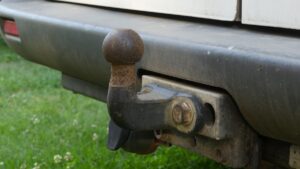
This is the complete beginner’s guide to trailer towing — everything you need to know before you hook up your first trailer and drive out of the driveway. We cover towing fundamentals, the numbers you must know, gear selection, safe loading, driving with a trailer, backing up, and the most common first-trip mistakes.
To tow a trailer safely as a beginner: confirm your vehicle’s towing capacity and payload, match the hitch class and ball size to the trailer, load 60% of cargo weight ahead of the axle for proper tongue weight, connect safety chains and lights, and check tire pressure before every trip. Drive slow, brake early, and take wide turns.
Not sure your setup is within limits? Check it in 30 seconds with our free towing capacity calculator.
Bookmark this page. Read it before your first trip. Come back to review the sections most relevant to your situation before every major tow.
Want structured, step-by-step training? Check out our online trailer towing course to learn everything you need to tow with confidence, plus earn a certificate of completion.
Table of Contents
TogglePart 1: Understanding Your Towing Numbers
Safe towing starts with math. Before you ever hook up a trailer, you need to understand four key ratings: your truck’s towing capacity, its payload rating, the trailer’s Gross Trailer Weight (GTW), and the tongue weight.
Towing Capacity
Towing capacity is the maximum amount of weight your tow vehicle can pull, as specified by the manufacturer. It is listed in your owner’s manual and on the door jamb sticker. Towing at or near the maximum rated capacity is legal, but you should aim to tow no more than 80% of your rated capacity for a comfortable safety margin.
READY TO STOP GUESSING?
LEARN THE RIGHT WAY. BUILD THE SKILLS TO TOW MORE SAFELY.
Build the skills to tow more safely. 51 video lessons, one-time payment.
ENROLL NOWOne-time payment - 30-Day money-back guarantee
Payload Rating
Payload is the total amount of weight your truck can carry inside the cab and bed, including passengers, cargo, and tongue weight. Adding a trailer’s tongue weight to the hitch receiver counts against your payload — and many trucks run out of payload before they run out of towing capacity. Always check both numbers.
GVWR and GCWR
GVWR (Gross Vehicle Weight Rating) is the maximum loaded weight of a single vehicle. GCWR (Gross Combined Weight Rating) is the maximum combined weight of the tow vehicle plus the trailer. If your loaded truck weighs 6,500 lbs and your loaded trailer weighs 8,000 lbs, your combination weight is 14,500 lbs — which must fall under your truck’s GCWR.
Tongue Weight
Tongue weight is the downward force the trailer’s coupler exerts on your hitch ball. It should be 10–15% of the trailer’s total loaded weight. Too little tongue weight and your trailer will sway. Too much and it squats the rear of your truck and lifts the front wheels — reducing your ability to steer and brake.
Part 2: Choosing the Right Hitch
Trailer hitches are rated in classes from Class I (up to 2,000 lbs) through Class V (up to 20,000 lbs). The hitch you need depends on the trailer weight you plan to pull. Never use a hitch rated below the weight of your loaded trailer.
For trailers that weigh more than half your truck’s GVWR, or when tongue weight exceeds 300 lbs, a weight distribution hitch is strongly recommended — and often required by your truck’s manufacturer. Weight distribution hitches use spring bars to level the truck and trailer and redistribute the tongue weight across all axles.
If your trailer is susceptible to trailer sway, consider adding a sway control bar or choosing a weight distribution head with integrated sway control. Read our full guide: How to Choose the Right Trailer Hitch.
Free Download
Never Miss a Safety Check Again
The exact 66-point checklist Jeff runs before every tow, so small problems get caught before they become breakdowns. Enter your email and we will send it over.
Free PDF · Instant download · No spam, unsubscribe any time
Part 3: Loading Your Trailer Correctly
Watch a Free Lesson
See how TowPro Academy teaches it step by step. Jeff McDonough, the founder, has 10+ years and 250,000+ miles of towing behind him.
How you load the trailer is just as important as what you’re towing. The golden rule: place 60% of cargo weight in front of the trailer’s axle and 40% behind it. This naturally produces appropriate tongue weight and makes the trailer track straight behind you.
Load heavier items low and close to the axle. Secure everything with tie-down straps — no loose objects in a trailer. An unsecured load that shifts mid-trip can transform a balanced trailer into an uncontrollable one.
Before departure, confirm your tongue weight with a scale and adjust cargo position if needed. Read our detailed guide: How to Load a Trailer Safely for Towing.
Part 4: Pre-Trip Safety Checks
Never leave the driveway without completing a full pre-trip inspection. This isn’t bureaucracy — it’s how experienced towers prevent roadside breakdowns and accidents.
Before every trip, check:
- Hitch connection: Ball is fully seated in the coupler, coupler latch is locked, safety pin is inserted.
- Safety chains: Crossed in an X under the tongue, connected to the truck’s hitch receiver — not the hitch ball mount.
- Trailer brakes: If your trailer has electric brakes, test the brake controller before driving. Gain should be set correctly for the trailer weight.
- Trailer lights: Check brake lights, turn signals, running lights, and backup lights with an assistant.
- Tire pressure: Inflate trailer tires to the pressure printed on the tire sidewall, not the truck door placard.
- Wheel lug nuts: Verify they are tight on both sides of the trailer’s axle.
- Breakaway cable: Connect the trailer breakaway cable to the truck — not the safety chains.
Use our full Pre-Trip Towing Checklist to make sure nothing is missed.
Part 5: Driving With a Trailer
Driving with a trailer changes almost everything about how your vehicle behaves. Here’s what to expect on your first trip:
- Braking distance increases significantly: The combined weight of truck and trailer requires much more stopping distance than the truck alone. Leave 4–5 seconds of following distance instead of the normal 2–3.
- Acceleration is slower: Don’t expect normal acceleration. Merge onto highways conservatively and use longer gaps in traffic.
- Turns require a wider arc: Your trailer tracks inside your truck’s turning radius. Swing wide on turns, especially right turns, to prevent the trailer tires from riding over curbs.
- Wind is a factor: Crosswinds, gusts from passing semi-trucks, and mountain passes can push the trailer sideways. Reduce speed in windy conditions.
- Downhill braking: On long downgrades, shift to a lower gear and use engine braking. Repeated hard braking overheats your brakes and can cause brake fade or failure.
Part 6: Backing Up a Trailer
Backing a trailer is the skill that intimidates first-time towers most — and with good reason. The trailer steers in the opposite direction from the truck when reversing. The key insight: when backing up, place your hand at the bottom of the steering wheel. Moving your hand left makes the trailer go left. Moving it right makes the trailer go right.
Start with small steering inputs. The trailer amplifies your movements. If the trailer starts to jack-knife (fold too sharply toward the truck), pull forward and start again. There is no shame in pulling forward to reset — experienced towers do it all the time. Read our step-by-step guide: How to Back Up a Trailer Straight.
Part 7: Trailer Safety Fundamentals
The most preventable towing accidents come from a small number of recurring failures. Knowing them in advance dramatically reduces your risk:
- Trailer tire blowouts: The leading cause of blowouts is underinflation. Check trailer tire pressure before every trip. Trailer tires also age faster than they wear — replace them every 5–6 years regardless of tread depth.
- Trailer sway: Caused by improper loading, insufficient tongue weight, or high speeds. Prevent it with correct load placement and appropriate speed. If sway begins, ease off the gas — do not brake hard.
- Unsecured loads: Every item in an open trailer should be strapped down. Even a loose tarp can become dangerous at highway speeds.
- Hitch separation: Always use a hitch pin and R-clip through the receiver tube. Always cross the safety chains. A separated trailer on a highway is a life-threatening situation.
Ready to Learn Everything?
This guide covers the fundamentals. TowPro Academy’s online trailer towing course goes deep on every topic — 51 video lessons, step-by-step demonstrations of hitching, backing, weight distribution setup, brake controller configuration, and emergency handling — all in a format you can watch on any device.
Not sure where to start? Read our Start Here guide for first-time towers or browse our towing glossary to learn the terminology before the first lesson.
Learn It Right the First Time
- 51 video lessons, hitching to backing to emergencies
- 950+ pages of PDF guides and checklists
- Final exam: score 80% to earn your certificate of completion
- 30-day refund if it is not for you
$79 through Oct 31 (regularly $99)
Frequently Asked Questions
What do I need to start towing a trailer for the first time?
You need a properly rated hitch and ball, correctly sized safety chains, a working trailer light connection, and a vehicle whose tow rating exceeds your loaded trailer weight. Confirm your tongue weight is 10–15% of total trailer weight.
How fast can I drive while towing a trailer?
Follow posted towing speed limits, which are often lower than car limits in many states. As a rule, keep speeds moderate (under 65 mph for most setups), increase following distance, and slow down well before curves and descents.
How do I stop a trailer from swaying?
Reduce speed gradually without slamming the brakes, keep the steering wheel straight, and ensure proper tongue weight and even load distribution. A weight distribution hitch with sway control helps prevent sway before it starts.
Do I need a special license to tow a trailer?
For most personal trailers a standard driver’s license is enough, but requirements vary by state and by combined weight. Heavier combinations may require a special endorsement, so check your state’s rules before towing.
Learn More with TowPro Academy
Ready to master every aspect of safe, confident towing? The full TowPro Academy towing course walks you through hitching, weight distribution, braking, backing up, and real-world road handling step by step — so you can hit the road prepared and tow with more confidence.
If you’re curious why I built TowPro Academy, here’s the story from me as the founder.
Stop guessing. Start towing with confidence.
The TowPro Course walks you through every skill in real road scenarios.
Step-by-step video lessons, a final exam, and printable lesson guides and checklists — everything in one place for $79 (fall special, reg. $99).
Enroll Now — $79 (Fall Special, reg. $99) →About the Author
Jeff McDonough
Founder of TowPro Academy, 10+ years and 250,000+ miles of towing experience.
He built TowPro Academy to give everyday trailer owners a clear, step-by-step way to learn what he learned on the road.
Read Full Bio →RELATED ARTICLES
- ›How to Turn With a Trailer: Right Turns, Left Turns and Tight Corners
- ›Towing a Trailer on the Highway: Merging, Lane Changes and Passing
- ›Do You Need a Special License to Tow a Trailer?
- ›Towing a Trailer in Snow, Ice and Rain: Winter Towing Tips
Ready to put it all together? Enroll in TowPro Academy and master safe towing in 51 step-by-step lessons.