Quick Answer: Backing a trailer straight requires understanding the counterintuitive relationship between steering direction and trailer direction. The key rule: put your hand at the bottom of the steering wheel and move it in the direction you want the rear of the trailer to go. Go slow. Use small corrections. Pull forward and reset often — there’s no shame in it.
Why Backing a Trailer Feels Backwards
When you back a car, the rear goes where you steer. When you back a trailer, the trailer does the opposite of what your instincts tell you. When you turn the steering wheel right, the rear of the trailer goes left. This counterintuitive behavior trips up every new tower — and many experienced ones.
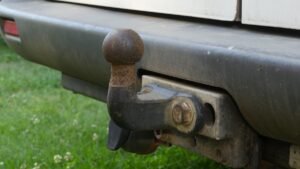
The pivot point is the hitch ball. Think of the trailer as a lever balanced at that pivot. When your truck turns right, the pivot point moves right, and the rear of the trailer swings left.
The Hand-on-the-Bottom Trick
Here’s the technique every towing instructor teaches:
Place your hand at the bottom of the steering wheel (6 o’clock position). Move that hand in the direction you want the rear of the trailer to go.
- Want the trailer rear to go left? Move your bottom hand left (which steers the truck right)
- Want the trailer rear to go right? Move your bottom hand right (which steers the truck left)
This trick physically overcomes your natural instinct to steer wrong. Practice it until it becomes automatic.
The Four Golden Rules of Trailer Backing
- Go slow. Backing is a slow-speed skill. Fast reversing amplifies mistakes and gives you no time to correct. Idle speed is usually fast enough.
- Make small corrections. Tiny steering inputs. The trailer amplifies everything — a small wheel movement makes a big trailer movement at the rear.
- Pull forward and reset often. This is not failure. Every professional tower pulls forward and straightens up regularly. It’s faster and easier than trying to recover from a severe jackknife angle.
- Know where your trailer corners are. Before backing, walk the area and identify obstacles. Know the width and length of your trailer. Check your mirrors constantly.
How to Back a Trailer Straight
- Position your truck and trailer as straight as possible before you start reversing. Get out and look if needed.
- Check both mirrors — identify the trailer in each mirror. You want to see equal amounts of trailer in both mirrors when going straight.
- Begin reversing very slowly.
- Watch for the trailer to drift in either mirror. As soon as one mirror shows more trailer than the other, make a tiny correction using the hand-at-bottom technique.
- As the trailer straightens back out, counter-steer to straighten the truck before you overshoot.
- Keep corrections small, speed slow, and pace steady.
How to Back Into a Spot (Offset Backing)
- Set up the approach. Position your truck so it’s offset from the target spot — typically you want to approach from an angle so the trailer swings into the target. Drive past the opening, then stop.
- Begin reversing with a steer toward the spot. Using the hand-at-bottom technique, steer to push the trailer rear toward the opening.
- Monitor both mirrors. Watch the trailer swing into the target. When the trailer is aimed into the spot, begin straightening the truck to follow it in.
- Finish with a straight back. Once the trailer is lined up, straighten out and back straight in.
- Check clearances before you reach them. Always stop, get out, and walk the space if you’re unsure about clearance on sides, overhead, or the rear.
Using a Spotter
A spotter standing behind and to the side with clear hand signals is invaluable when backing into tight spots. Agree on signals before you start: arm up = stop, rotate finger = keep coming, arms wide = you have room. Never rely solely on a spotter — also check your own mirrors.
Extended Mirrors and Camera Systems
Towing mirrors that extend beyond the trailer’s width are essential — and in many states, legally required if the trailer is wider than the stock mirrors. Many towing setups benefit from a backup camera, ideally a wireless camera mounted on the rear of the trailer so you can see exactly what’s behind the trailer, not just behind the truck.
Common Backing Mistakes to Avoid
- Going too fast — the #1 mistake, always
- Over-correcting — a tiny drift becomes a jackknife
- Not pulling forward to reset — pride is expensive
- Not walking the area before backing — surprises cost bumpers
- Letting the jackknife angle get too sharp before correcting — once you’re past about 90 degrees, you cannot recover; pull forward
Practice Tips for Beginners
Find an empty parking lot and use traffic cones to simulate a backing target. Start with wide-open space and gradually tighten the target. Practice backing straight first, then gentle curves, then offset backing into a simulated spot. An hour of deliberate parking lot practice is worth more than 10 hours of trial-and-error on real trips.
WATCH IT IN ACTION
Master Trailer Backing With Video Lessons
TowPro Academy includes detailed video lessons on backing, maneuvering, and parking a trailer — with real demonstrations in tight spaces.
Explore TowPro Academy →Related Guides
Related Articles
- Backing a Trailer With Confidence
- First-Time Towing: What Nobody Tells You
- Start Here: Your First Steps to Safe Trailer Towing
- Towing Glossary: Every Key Towing Term Defined
Ready to put this into practice?
The TowPro Course walks you through every skill in real road scenarios.
Step-by-step video instruction, towing calculators, and a printable checklist — everything in one place for $50.
Enroll Now — $50 →Read Next
- How to Back a Boat Trailer
- Complete Beginner’s Guide to Trailer Towing
- What Is Trailer Sway?
- Towing Capacity Guide
- Full Towing Glossary
Related Articles


FREE DOWNLOAD
Pre-Trip Towing Checklist
66 must-check items before every tow — print it or save as PDF. Created by Jeff McDonough with 200,000+ miles of towing experience.
✅ Get the Free Checklist