
Trailer sway is one of the most terrifying experiences a driver can have on the road. One moment you’re cruising along the highway, the next your trailer is swinging from side to side and pulling your truck with it. The good news: sway is almost always preventable — and if it does happen, knowing how to respond can save your life.
TowPro Academy Course
Stop Guessing. Start Towing Right.
51 video lessons • 950+ pages of downloadable lesson guides • 6 modules • 30-day money-back guarantee. Jeff covers every topic in this article and more — step by step, on video.
Enroll Now — $79 through Oct 31 (regularly $99)Access for as long as the course is hosted • No subscriptionTable of Contents
ToggleWhat Is Trailer Sway?
Trailer sway (also called “trailer fishtailing” or “yaw”) happens when the rear of your trailer starts swinging side to side in an oscillating motion. Once it starts, it can escalate rapidly — each swing getting wider until the trailer jackknifes or pulls the tow vehicle off the road. It can develop within seconds, especially at highway speeds.
Why Does Trailer Sway Happen?
Sway has several root causes, and most of them come down to physics — specifically the relationship between your trailer’s weight distribution and the forces acting on it while driving.
1. Improper Weight Distribution
This is the number one cause of trailer sway. If too much of the trailer’s weight is loaded behind the axle, the rear of the trailer becomes the heavier end — and like a pendulum, it wants to swing. The general rule is 60% of your trailer’s cargo weight should be in front of the axle, 40% behind. If your trailer’s tongue weight is less than 10% of the total trailer weight, you’re at high risk for sway.
2. Speed
Trailer sway almost always occurs at higher speeds. Most trailers have a critical speed threshold — once you exceed it, even a small disturbance can trigger oscillation. This is why highway on-ramps and passing maneuvers are particularly risky. Many experienced towers reduce speed by 5–10 mph below the speed limit when towing, especially in crosswind conditions.
READY TO STOP GUESSING?
LEARN THE RIGHT WAY. BUILD THE SKILLS TO TOW MORE SAFELY.
Build the skills to tow more safely. 51 video lessons, one-time payment.
ENROLL NOWOne-time payment - 30-Day money-back guarantee
3. Wind and Crosswinds
A strong crosswind or the wind blast from a passing semi-truck can push your trailer sideways and trigger sway. Large, flat-sided trailers (like fifth wheels, toy haulers, and enclosed cargo trailers) are especially vulnerable because they act like a sail. Driving through open terrain, gaps between hills, or exposed bridges amplifies crosswind effects significantly.
4. Sudden Steering Inputs
Sudden lane changes, swerving to avoid an obstacle, or jerking the wheel at speed can induce sway. The trailer takes a moment to respond to steering inputs — and the resulting out-of-phase oscillation is what triggers the fishtailing motion. Smooth, gradual steering inputs are essential when towing.
5. Overloaded or Underloaded Trailer
Towing at the very edge of your capacity reduces your vehicle’s ability to control trailer movement. An underloaded trailer (especially one towed empty at highway speed) can also be prone to sway because there’s very little tongue weight to stabilize it. Empty car trailers, flatbeds, and utility trailers are particularly susceptible to sway when unloaded.
6. Tire Issues
Underinflated or unevenly inflated trailer tires can contribute to sway by changing the trailer’s handling characteristics. A blowout on a trailer tire is also a common trigger for sudden, severe sway. Always check trailer tire pressure before every trip and inspect tires for signs of wear, cracking, or aging.
How to Stop Trailer Sway When It Starts
Watch a Free Lesson
See how TowPro Academy teaches it step by step. Jeff McDonough, the founder, has 10+ years and 250,000+ miles of towing behind him.
If your trailer starts to sway, every second counts. Here’s exactly what to do — and critically, what NOT to do:
DO: Stay Calm and Hold the Wheel Straight
Your instinct will be to steer into the sway or make corrections. Resist this. Jerking the wheel will almost always make the sway worse. Keep your hands firm on the wheel and focus on maintaining a straight line of travel.
Free Download
Never Miss a Safety Check Again
The exact 66-point checklist Jeff runs before every tow, so small problems get caught before they become breakdowns. Enter your email and we will send it over.
Free PDF · Instant download · No spam, unsubscribe any time
DO: Ease Off the Accelerator Gradually
Lift your foot off the gas slowly and let the vehicle decelerate naturally. Reducing speed is the most effective thing you can do to stop sway — the oscillation dampens as speed drops. Do not accelerate, even if it feels like power will stabilize the trailer.
DO: Use the Trailer Brakes (If Equipped)
If you have a trailer brake controller, manually activating the trailer brakes (without applying your tow vehicle’s brakes) is one of the most effective emergency sway corrections available. Braking the trailer while the tow vehicle continues forward straightens the trailer behind you. Most brake controllers have a manual override slider for exactly this purpose.
DON’T: Brake Hard with Your Tow Vehicle
Hard braking on the tow vehicle during active sway is one of the worst things you can do. It shifts weight forward, reduces rear-axle control, and can cause the trailer to push the rear of your vehicle sideways — potentially flipping both the truck and trailer. If you must brake, brake very gently and apply trailer brakes first if possible.
DON’T: Try to Steer Out of Sway
Counter-steering during sway almost always makes it worse. The trailer and tow vehicle are out of phase — trying to correct with the steering wheel can amplify the oscillation to the point of jackknifing. Keep the wheel straight and focus on slowing down.
How to Prevent Trailer Sway Before It Starts
Prevention is far better than emergency response. Here are the most effective ways to prevent sway before you ever leave the driveway.
Load Your Trailer Correctly
Put 60% of the weight in front of the trailer axle, 40% behind. Keep heavy items low and centered. Measure your tongue weight with a tongue weight scale (available for under $50 at most trailer supply stores) and confirm it’s 10–15% of the total loaded trailer weight before every major trip.
Use a Weight Distribution Hitch
For trailers over 5,000 lbs (or any trailer with high tongue weight), a weight distribution hitch (WDH) is one of the best investments you can make. A WDH uses spring bars to redistribute tongue weight across all four axles of the truck and trailer combination, dramatically improving stability and reducing sway risk. Many manufacturers require a WDH at certain weight thresholds to maintain warranty coverage.
Add a Sway Control Device
Friction sway controls (a bar that runs diagonally between the trailer tongue and hitch) add mechanical resistance to lateral trailer movement, making it much harder for sway to develop. Dual-cam sway control systems (integrated into weight distribution hitches) are even more effective. Electronic trailer sway control (ESC), now standard on many modern trucks and SUVs, automatically applies individual wheel brakes to counter trailer oscillation before it escalates.
Slow Down
Speed is the single biggest factor in sway risk. Every trailer has a critical speed beyond which it becomes unstable. Tow at 55–60 mph instead of 70+ and you dramatically reduce your risk. This is especially true in windy conditions, on twisting roads, or when towing a large-profile trailer like a fifth wheel or enclosed cargo trailer.
Maintain Proper Tire Pressure
Check both your tow vehicle tires and trailer tires before every trip. Inflate to the pressure listed on the tire sidewall (for trailer tires) or the sticker inside your truck’s door jamb (for tow vehicle tires). Proper inflation ensures predictable handling and reduces the chance of a blowout triggering sudden sway.
Check Your Hitch Connection
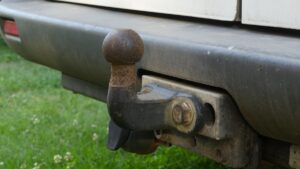
A loose hitch ball, worn coupler, or improperly torqued hitch components can create play in the connection that amplifies sway. Ensure the coupler is fully seated on the ball and locked, the locking pin or clip is in place, and all hitch bolts are torqued to spec. A ball mount that is too drop or too rise for your trailer can also affect stability.
Electronic Trailer Sway Control: What Modern Trucks Offer
Most trucks and SUVs built after 2010 include some form of electronic trailer sway control as part of their stability control system. When the system detects trailer oscillation, it automatically applies individual wheel brakes to correct it — often before the driver is even aware the sway has started. This technology has saved countless lives and is one of the best passive safety features available to towers today.
However, electronic sway control is not a substitute for proper loading, appropriate speed, and good equipment. It’s a last line of defense, not a license to tow improperly loaded trailers at 80 mph. Know your vehicle’s capabilities and use the technology as a backup, not a crutch.
The Bottom Line on Trailer Sway
Trailer sway is almost always the result of preventable setup and loading mistakes. Load your trailer correctly with 60% of weight ahead of the axle. Maintain a tongue weight of 10–15% of total trailer weight. Use a weight distribution hitch for heavier loads. Keep your speed in check. Inspect tires before every trip. And if sway does happen: let off the gas, hold the wheel straight, activate trailer brakes manually if you can, and let the vehicle slow naturally.
Want to master these skills before you’re in a stressful situation? TowPro Academy’s truck towing course covers weight distribution, sway control, hitch setup, and every other critical towing skill — 51 video lessons for a one-time payment of $79.
Windy day ahead? Read our guide to towing a trailer in high winds.
Sway is most likely when you pass or get passed by big rigs. Our guide to towing a trailer on the highway covers safe merging, lane changes and passing.
Further Reading
- Towing Capacity Explained: How to Find Your Truck’s Limit
- The Pre-Trip Towing Checklist Every Driver Needs
- How to Tow Safely in Bad Weather
Related: If you’re dealing with sway and don’t have a weight distribution hitch — or aren’t sure yours is set up correctly — see our complete guide on weight distribution hitch setup. A properly tensioned WDH is one of the most effective sway prevention tools available. For technical context on how Electronic Stability Control systems detect and respond to trailer sway, NHTSA’s Electronic Stability Control resource explains how modern tow vehicles use ESC to mitigate dangerous oscillations.
What causes trailer sway?
Trailer sway is most commonly caused by improper weight distribution — specifically too much weight behind the trailer axle. Other causes include excessive speed, crosswinds, sudden steering inputs, overloaded or underloaded trailers, and worn or underinflated trailer tires. The root issue is almost always a weight or speed problem that shifts the trailer's center of gravity.
How do you stop trailer sway once it starts?
If trailer sway starts, do not brake hard or try to steer out of it. Instead: stay calm, ease off the accelerator gradually, hold the steering wheel firmly but straight, and let the truck slow down naturally. If your brake controller has a manual override button, pressing it to apply the trailer brakes alone can help straighten the trailer. Only pull over safely once the sway has stopped.
How much tongue weight do you need to prevent trailer sway?
To prevent sway, your tongue weight should be 10–15% of the total loaded trailer weight. For example, a 6,000 lb trailer should have 600–900 lbs of tongue weight. Too little tongue weight is the single most common cause of trailer sway. Loading 60% of your cargo in the front half of the trailer is the easiest way to achieve this.
Does a weight distribution hitch prevent trailer sway?
A weight distribution hitch improves stability by redistributing tongue weight across all four wheels of the tow vehicle, but it is not a sway control device on its own. For dedicated sway prevention, you need a friction sway control bar or an electronic sway control system. Many weight distribution hitches can be paired with a friction sway bar for combined benefit.
At what speed does trailer sway become dangerous?
Trailer sway risk increases significantly above 55 mph, and becomes serious above 65 mph, especially with a heavy trailer or crosswinds. Most towing experts recommend keeping loaded trailer speeds at or below 65 mph on the highway. Some states also have lower speed limits specifically for vehicles towing trailers.
Related Articles
- What Is Tongue Weight? (The Number That Controls Trailer Sway)
- What Is GVWR?
- How to Load a Trailer Properly
- Weight Distribution Hitch Setup Guide
- Towing Glossary: Every Key Towing Term Defined
Ready to Tow With Confidence?
TowPro Academy is a trailer towing course built for truck owners who tow their own trailers. 51 lessons covering everything from hookup to backing up — one-time payment, learn at your own pace.
Start the Course — $79 One-TimeStop guessing. Start towing with confidence.
The TowPro Course walks you through every skill in real road scenarios.
Step-by-step video lessons, a final exam, and printable lesson guides and checklists — everything in one place for $79 (fall special, reg. $99).
Enroll Now — $79 (Fall Special, reg. $99) →Read Next
About the Author
Jeff McDonough
Founder of TowPro Academy, 10+ years and 250,000+ miles of towing experience.
He built TowPro Academy to give everyday trailer owners a clear, step-by-step way to learn what he learned on the road.
Read Full Bio →RELATED ARTICLES
- ›Night Towing: Tips and Techniques for Safe After-Dark Driving
- ›How to Buy a Used Trailer: What to Look For Before You Commit
- ›Towing Laws by State: What Every Driver Needs to Know
- ›Trailer Maintenance Schedule: What to Inspect, When, and Why
Ready to put it all together? Enroll in TowPro Academy and master safe towing in 51 step-by-step lessons.
Related Articles


Learn It Right the First Time
- 51 video lessons, hitching to backing to emergencies
- 950+ pages of PDF guides and checklists
- Final exam: score 80% to earn your certificate of completion
- 30-day refund if it is not for you
$79 through Oct 31 (regularly $99)