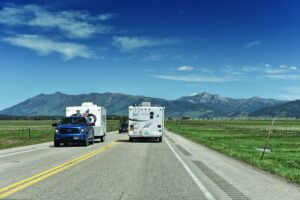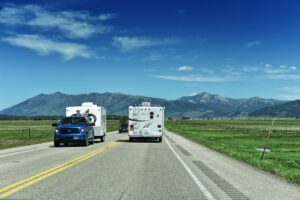
Highway driving is where a lot of new towers feel the most nervous. Around town you’re going slow and have room to think. On the freeway, everything happens faster, and your truck and trailer are longer, heavier and slower to stop than the traffic around you. The good news is that safe highway towing comes down to a handful of habits you can learn and practice.
This guide covers merging, choosing a lane, following distance, changing lanes, passing, getting passed by big rigs, and exiting, all with a trailer behind you.
Quick Answer: How to Tow Safely on the Highway
- Leave much more following distance than you would without a trailer, and add more in rain, wind or darkness.
- Stay in the right-hand lanes and drive at or below the posted towing speed limit for your state.
- Use the full on-ramp to build speed, signal early, and merge where there’s a real gap.
- Before changing lanes, check your towing mirrors twice, signal early and move over slowly.
- Pass rarely, and only when you have plenty of room to get back over.
- Slow down early for exits and curves, before you’re in them.
Before You Get on the Highway
Most highway problems start in the driveway. Before any long drive, make sure the trailer is loaded with the right tongue weight, your safety chains are crossed and connected, your lights work, and your brake controller is set. A trailer that’s loaded tail-heavy or has weak brakes can feel fine at 25 mph and become a handful at highway speed. Our pre-trip towing checklist walks through all of it.
Also adjust your mirrors before you leave. You should be able to see down both sides of the trailer and into the lanes beside it. If your standard mirrors can’t show you that, you need towing mirrors.
Merging Onto the Highway
Watch a Free Lesson
See how TowPro Academy teaches it step by step. Jeff McDonough, the founder, has 10+ years and 250,000+ miles of towing behind him.
A loaded truck and trailer accelerates much more slowly than an empty vehicle, so merging takes planning.
- Use the whole on-ramp. Start accelerating firmly as soon as you’re on the ramp. Don’t creep down it and expect to make up speed at the end.
- Look early. Check your mirror and over your shoulder for a gap while you’re still on the ramp, not at the merge point.
- Signal early so drivers in the right lane have time to make room.
- Merge into a real gap. Remember that you need room for the whole rig, not just your truck. A space that looks big enough for a car may not fit you plus a trailer.
- Don’t stop on the ramp unless you truly have to. Starting from a stop at the bottom of a ramp with a trailer is much harder than merging at speed.
Picking Your Lane
When you’re towing, the right lane is usually your home. You’re likely going slower than general traffic, and staying right keeps faster vehicles from stacking up behind you. Some states require it. California, for example, requires vehicles towing a trailer to drive in the right-hand lane, or the lane just to the left of it on highways with four or more lanes in one direction (California Vehicle Code §21655). Rules vary, so check our guide to maximum towing speed by state and lane rules before a long trip.
When you’re passing busy on-ramps, it can help to move one lane left (where it’s allowed) so merging traffic has room, then return to the right lane once you’re clear.
READY TO STOP GUESSING?
LEARN THE RIGHT WAY. BUILD THE SKILLS TO TOW MORE SAFELY.
Build the skills to tow more safely. 51 video lessons, one-time payment.
ENROLL NOWOne-time payment - 30-Day money-back guarantee
Following Distance and Speed
Your truck and trailer take longer to stop than the car in front of you, so the normal following distance isn’t enough. A simple method is to count seconds: when the vehicle ahead passes a sign or overpass, count how long it takes you to reach the same spot. Give yourself noticeably more time than you would without a trailer, and add even more at night, in rain, or on downhill grades.
Free Download
Never Miss a Safety Check Again
The exact 66-point checklist Jeff runs before every tow, so small problems get caught before they become breakdowns. Enter your email and we will send it over.
Free PDF · Instant download · No spam, unsubscribe any time
A bigger gap also gives you something just as important: time. If traffic ahead suddenly slows, you can brake smoothly instead of slamming on the brakes, which is how many jackknife and sway problems begin.
Keep your speed moderate. Trailer tires often have lower speed ratings than car tires, sway is more likely as speed goes up, and many states set a lower speed limit for vehicles towing trailers. If you feel the trailer start to wander or sway, ease off the gas, keep the steering wheel straight, and see our guide to trailer sway control.
Changing Lanes With a Trailer
Lane changes are where towing mistakes happen, because the trailer creates large blind spots and makes your rig much longer than it feels from the driver’s seat.
- Check your mirrors, then check again. Small cars and motorcycles can hide beside the trailer.
- Signal early and hold the signal for a few seconds before you move.
- Move over slowly and gradually. A quick jerk of the wheel at highway speed can start the trailer swaying.
- Make sure the trailer is clear before you move back. Use your mirror to confirm the back of the trailer is well past the vehicle you passed. Many drivers wait until they can see the whole front of that vehicle in the mirror.
Passing (and Being Passed)
Passing with a trailer takes a lot of road, because you accelerate slowly and you’re long. On a two-lane highway, it’s usually smarter to stay patient than to risk a pass. On a multi-lane freeway, only pass when you have plenty of open space ahead and you’ve checked the lane carefully.
When a semi truck or bus passes you, you’ll often feel a push of air, first away from the truck and then a pull back toward it as it goes by. Expect it. Keep a firm grip on the wheel, stay steady, and avoid sudden steering or braking. Moving to the right side of your lane, when it’s safe, gives a little more room. The same goes for strong crosswinds; see our tips for towing a trailer in high winds.
Hills, Curves and Exits
Slow down before curves and exit ramps, not in them. Braking hard in the middle of a curve can push the trailer and upset your rig. On long climbs, let your speed drop, use the right lane, and watch your engine and transmission temperature. On long descents, downshift and let the engine help hold your speed so your brakes don’t overheat. Our guide to towing on uphill and downhill grades covers this in detail.
For exits, signal well ahead, move into the exit lane early, and start slowing on the off-ramp. If you miss your exit, take the next one. Never back up or cut across lanes at the last second.
Take Breaks
Towing on the highway takes more focus than normal driving, and it’s tiring. Plan stops every couple of hours. Each time you stop, walk around the rig: check the hitch, safety chains, lights, tires, and feel the wheel hubs for unusual heat.
Build Highway Confidence Before the Big Trip
The best way to get comfortable is to practice on a quiet stretch of highway at a low-traffic time before your first long trip. If you’re new to towing, our first-time towing guide is a good place to start, and you can check your setup with the towing capacity calculator.
TowPro Academy was built by Jeff McDonough, founder of TowPro Academy, who has 10+ years and more than 250,000 miles of towing experience. Want to learn hookup, highway and maneuvering skills step by step? Start with the free lesson, or enroll in the full course (Fall Special $79, regularly $99) at checkout.towproacademy.com/enroll.
Learn It Right the First Time
- 51 video lessons, hitching to backing to emergencies
- 950+ pages of PDF guides and checklists
- Final exam: score 80% to earn your certificate of completion
- 30-day refund if it is not for you
$79 through Oct 31 (regularly $99)
Frequently Asked Questions
What lane should I drive in when towing a trailer?
Usually the right lane. You’ll typically be going slower than other traffic, and some states, like California, require towing vehicles to stay in the right-hand lanes on multi-lane highways.
How much following distance do I need when towing?
Much more than you’d leave without a trailer. Use the seconds-counting method and give yourself extra time, then add more in rain, wind, darkness or on downhill grades.
How do I know when it’s safe to move back over after passing?
Wait until your mirror shows the back of your trailer is well clear of the vehicle you passed. Many drivers wait until they can see that vehicle’s whole front end in the mirror, then signal and move over gradually.
Why does my trailer move when a semi passes me?
Large trucks push air as they pass, which can nudge your trailer away and then pull it back. Keep a firm grip, hold the wheel steady, and avoid sudden steering or braking.
Stop guessing. Start towing with confidence.
The TowPro Course walks you through every skill in real road scenarios.
Step-by-step video lessons, a final exam, and printable lesson guides and checklists — everything in one place for $79 (fall special, reg. $99).
Enroll Now — $79 (Fall Special, reg. $99) →RELATED ARTICLES
- ›How to Turn With a Trailer: Right Turns, Left Turns and Tight Corners
- ›Do You Need a Special License to Tow a Trailer?
- ›Towing a Trailer in Snow, Ice and Rain: Winter Towing Tips
- ›Towing a Trailer in High Winds: How to Stay Safe
Ready to put it all together? Enroll in TowPro Academy and master safe towing in 51 step-by-step lessons.