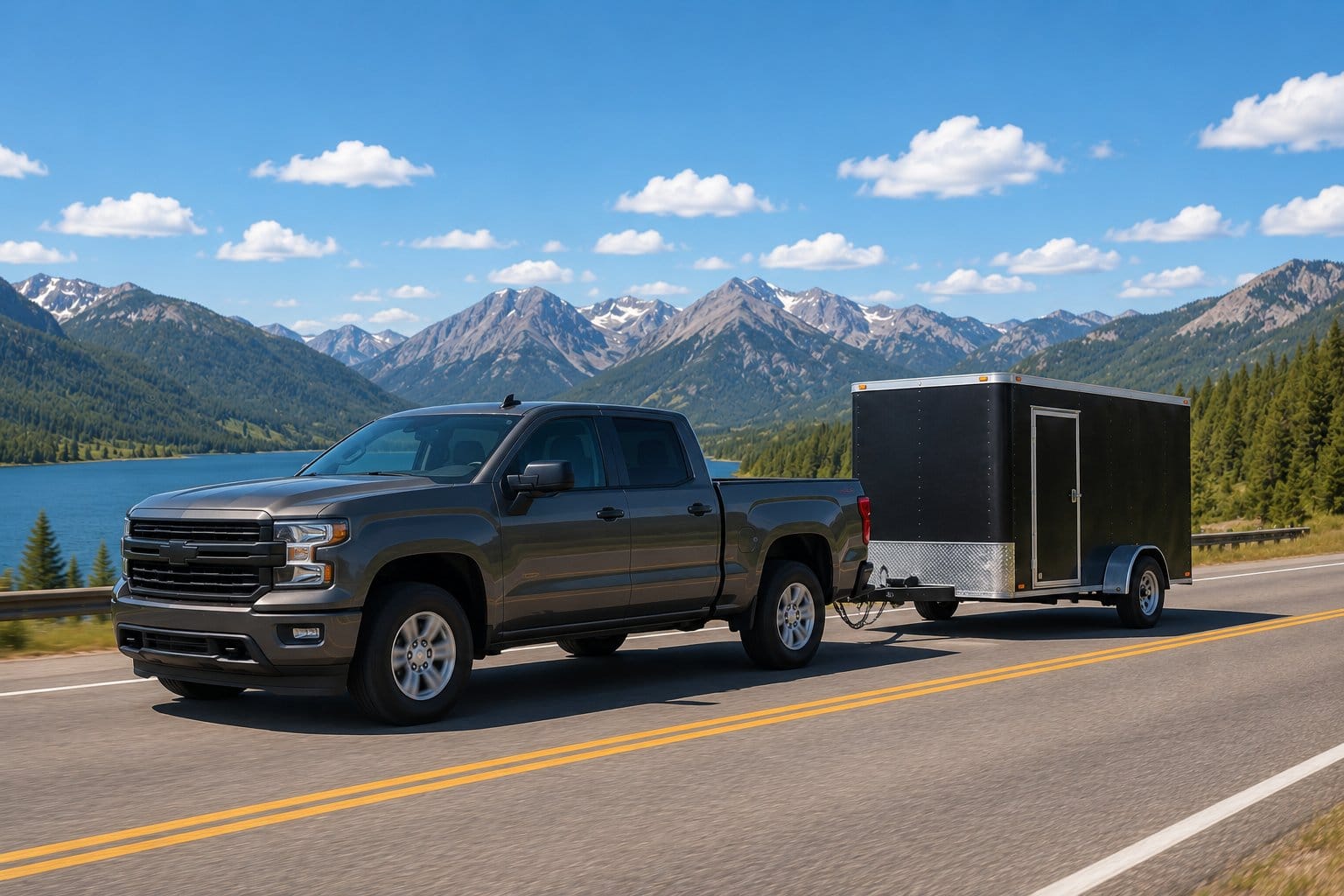
Short answer: slow down, give yourself more room, and be ready to park. Wind pushes on the big flat side of a trailer, especially a tall travel trailer or empty enclosed cargo trailer, and that push can start sway. There’s no single wind speed that’s safe for every rig. A heavy, well-loaded trailer with a weight distribution hitch and sway control handles gusts far better than a light, tall, empty one. The safest call is to check the forecast for gusts (not just average wind), and if you’re fighting the wheel or the trailer is getting shoved around, get off the road and wait it out.
Why Wind Affects a Trailer So Much
A travel trailer or enclosed trailer can present a side area many times larger than your tow vehicle. A crosswind pushes that whole surface sideways, and because the trailer pivots on the hitch ball, the push turns into a yawing motion that you feel through the steering wheel. Gusts are worse than steady wind because they hit suddenly and let go suddenly. Passing semis, bridges, overpasses and gaps between hills all create the same effect in smaller doses.
Lighter and taller trailers catch more wind for their weight. An empty cargo trailer or a lightweight camper is often the hardest to keep straight, while a low, heavy flatbed or utility trailer is affected much less.
Before You Leave: Check the Forecast
- Look at gusts, not just the average. Most weather apps and the National Weather Service forecast at weather.gov list wind gust speeds. A 15 mph average with 40 mph gusts is a very different day than a steady 15.
- Watch for wind advisories and high wind warnings along your route, especially through mountain passes, open plains, deserts and long bridges.
- Check state DOT road alerts. Some states post restrictions for high-profile vehicles on certain highways and bridges during strong wind.
- Consider leaving early or a day later. Wind often picks up in the afternoon in many areas. Moving your departure can be the easiest fix.
Set Up Your Rig to Handle Wind Better
Watch a Free Lesson
See how TowPro Academy teaches it step by step. Jeff McDonough, the founder, has 10+ years and 250,000+ miles of towing behind him.
- Get tongue weight right. Aim for roughly 10 to 15% of trailer weight on the tongue for a conventional trailer. Too little tongue weight is one of the most common causes of sway. See our guide to the tongue weight 10-15% rule.
- Load heavy items low and centered over the axles, and secure everything so it can’t shift. More on that in how to load a trailer.
- Use a weight distribution hitch and sway control on travel trailers where the manufacturer recommends it. A properly adjusted hitch keeps weight on your front axle so steering stays responsive. See how to adjust a weight distribution hitch and our trailer sway control guide.
- Check tire pressure cold on both the tow vehicle and trailer. Soft tires make the whole combination feel loose.
- Set your brake controller gain so you can apply the trailer brakes alone if you need to. Our trailer brake controller guide walks through it.
- Stay within your ratings. An overloaded tow vehicle has less control in every condition. Run your numbers with the free towing capacity calculator.
How to Drive When It’s Windy
- Slow down. Speed makes sway worse and gives you less time to react. Dropping your speed is the single most effective thing you can do.
- Keep both hands on the wheel and make small, smooth corrections. Big steering inputs can make the trailer swing more.
- Increase following distance so you never have to brake hard or swerve.
- Expect gusts at gaps. Coming out from behind a hill, a line of trees, an overpass or a building, be ready for a sudden shove.
- Be ready when big trucks pass. The air they push can nudge your trailer first one way, then the other. Hold a steady line and ease off the gas slightly.
- Use cruise control sparingly. In gusty wind you want direct control of your speed.
If the Trailer Starts to Sway
Take your foot off the gas, hold the steering wheel as straight as you can, and apply the trailer brakes gently with the manual lever on your brake controller. That pulls the trailer back in line behind you. Don’t slam on the tow vehicle’s brakes and don’t try to steer out of it with big corrections. Once the trailer settles, slow down further, and pull over somewhere safe to check your load and hitch.
When to Park and Wait It Out
Pull over when you’re constantly correcting the steering, when gusts are pushing you out of your lane, or when a high wind warning covers the road ahead. Find a safe spot such as a rest area, truck stop or large parking lot, and if you can, park with the nose of the trailer pointed into the wind so the side isn’t taking the full force. Losing an afternoon is always better than losing control.
In 10+ years and 250,000+ miles of towing, I’ve learned that wind days are when patience pays off most. Planning around the weather is part of being a confident tower.
Want to build that confidence step by step? Start with the free lesson, or enroll in the full TowPro Academy course (Fall Special $79, regularly $99) at checkout.towproacademy.com/enroll.
READY TO STOP GUESSING?
Free Download
Never Miss a Safety Check Again
The exact 66-point checklist Jeff runs before every tow, so small problems get caught before they become breakdowns. Enter your email and we will send it over.
Free PDF · Instant download · No spam, unsubscribe any time
LEARN THE RIGHT WAY. BUILD THE SKILLS TO TOW MORE SAFELY.
Build the skills to tow more safely. 51 video lessons, one-time payment.
ENROLL NOWOne-time payment - 30-Day money-back guarantee
Heading out in cold weather? See our guide to towing a trailer in snow, ice and rain.
Learn It Right the First Time
- 51 video lessons, hitching to backing to emergencies
- 950+ pages of PDF guides and checklists
- Final exam: score 80% to earn your certificate of completion
- 30-day refund if it is not for you
$79 through Oct 31 (regularly $99)
Frequently Asked Questions
What wind speed is too high to tow a travel trailer?
There’s no single number that fits every rig. It depends on your trailer’s height and weight, how it’s loaded, your hitch setup and your tow vehicle. Light, tall trailers are affected at lower wind speeds than heavy, low ones. Pay attention to gust forecasts and to how the rig feels. If you’re working hard to stay in your lane, it’s too windy.
Is an empty trailer worse in wind?
Often, yes. An empty enclosed or cargo trailer has the same large side area but much less weight holding it down, so gusts move it around more easily.
Does a weight distribution hitch help in wind?
A properly adjusted weight distribution hitch restores weight to the tow vehicle’s front axle, which improves steering and braking. Pairing it with sway control helps resist the trailer’s side-to-side motion. Neither replaces slowing down.
Should I drive faster to get through windy areas sooner?
No. Higher speed makes sway more likely and harder to correct. Slow down, or wait for the wind to drop.
Stop guessing. Start towing with confidence.
The TowPro Course walks you through every skill in real road scenarios.
Step-by-step video lessons, a final exam, and printable lesson guides and checklists — everything in one place for $79 (fall special, reg. $99).
Enroll Now — $79 (Fall Special, reg. $99) →RELATED ARTICLES
- ›Do You Need a Special License to Tow a Trailer?
- ›Towing a Trailer in Snow, Ice and Rain: Winter Towing Tips
- ›Maximum Towing Speed by State: Where Trailer Speed Limits Are Lower
- ›Trailer Brake Requirements by State: When Does Your Trailer Need Its Own Brakes?
Ready to put it all together? Enroll in TowPro Academy and master safe towing in 51 step-by-step lessons.