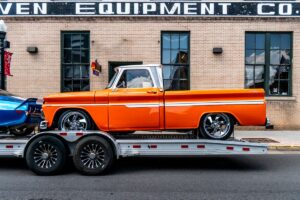
Turning is one of the first things that surprises new towers. You make a right turn the way you always have, and suddenly the trailer tire is up on the curb, or worse, clipping a sign post. That happens because a trailer doesn’t follow your truck’s path. It cuts the corner. Once you understand why, turning with a trailer becomes a simple, repeatable habit.
This guide covers why trailers cut corners, how to make right turns and left turns, how to handle tight corners and gas stations, and the most common turning mistakes.
Quick Answer: How to Turn With a Trailer
- Slow down well before the turn and finish your braking while you’re still going straight.
- Pull farther into the intersection than you normally would before you start turning the wheel.
- Turn later and wider so the trailer wheels clear the curb.
- Watch the trailer wheels in your mirror on the inside of the turn, not just the road ahead.
- Keep your speed low and steady through the turn, then straighten out gradually.
Why a Trailer Cuts Corners
Your trailer is pulled from the hitch ball, which sits behind your rear axle. As you turn, the trailer’s wheels take a shorter path than your tow vehicle’s wheels, tracking toward the inside of the turn. This is called off-tracking. The longer the distance from the hitch ball to the trailer axle, the more the trailer cuts in. A short utility trailer cuts in a little. A long travel trailer or car hauler cuts in a lot.
That’s why the normal turn you make in your truck alone will drag the trailer over the curb. You have to steer the trailer’s path, not just your own.
How to Make a Right Turn With a Trailer
Watch a Free Lesson
See how TowPro Academy teaches it step by step. Jeff McDonough, the founder, has 10+ years and 250,000+ miles of towing behind him.
Right turns are where most curb strikes happen, because the inside of the turn is right next to the curb.
- Slow down early. Brake while you’re still going straight, so you enter the turn slowly and under control.
- Signal early. Give drivers behind you plenty of warning, since you’ll be moving slowly and may need to position a little wider.
- Stay in your lane, but don’t hug the curb. Keep your tow vehicle toward the left side of your lane so you have room on the right.
- Pull forward before you turn. Drive straight farther into the intersection than usual, until your front wheels are about even with the curb line of the road you’re turning onto. Then start your turn.
- Watch your right mirror. Keep an eye on the trailer’s right wheels as they come around. If they’re getting close to the curb, ease forward a bit more before turning harder.
- Straighten out gradually. As the trailer clears the corner, return the wheel to center and settle into your new lane.
Avoid swinging left into the oncoming lane to set up a right turn. Drivers behind you may read that as a left turn and try to pass on your right, right where your trailer is about to go.
How to Make a Left Turn With a Trailer
Left turns usually give you more room, but they bring their own risks.
READY TO STOP GUESSING?
LEARN THE RIGHT WAY. BUILD THE SKILLS TO TOW MORE SAFELY.
Build the skills to tow more safely. 51 video lessons, one-time payment.
Free Download
Never Miss a Safety Check Again
The exact 66-point checklist Jeff runs before every tow, so small problems get caught before they become breakdowns. Enter your email and we will send it over.
Free PDF · Instant download · No spam, unsubscribe any time
One-time payment - 30-Day money-back guarantee
- Go a little past the center of the intersection before turning so the trailer doesn’t cut across the corner or clip a median or a car waiting at the light.
- Allow a bigger gap in oncoming traffic. Your rig is longer and slower to clear the intersection than a car alone. Wait for a gap that covers your truck and the whole trailer.
- Finish in the correct lane. Aim to end the turn in the lane you’d normally use, and check your left mirror so the trailer isn’t drifting across the lane line.
Tight Corners, Parking Lots and Gas Stations
Tight spaces are where planning matters most.
- Look before you pull in. At a gas station, check whether you can drive straight through and out the other side. Choose the outer pumps or truck lanes when they’re available so you’re not boxed in.
- Know your exit. Don’t pull into a lot or driveway unless you can see how you’ll get back out. Backing a trailer out of a crowded spot is much harder than driving forward.
- Watch for poles, posts and curbs. Fuel pump islands, light poles and concrete barriers sit right where your trailer will cut the corner.
- Get out and look. If you’re not sure the trailer will clear, stop and walk around. It takes thirty seconds and can save a lot of damage. A spotter helps too.
If you do end up needing to reverse, our guide on how to back up a trailer walks through it step by step.
Common Turning Mistakes
- Turning too early. This is the number one cause of curb strikes. Pull forward first, then turn.
- Turning too fast. Speed in a turn shifts weight, stresses tires and can make a heavy trailer push your tow vehicle. Slow and steady wins.
- Only watching the road ahead. The front of your rig will be fine. It’s the trailer wheels you need to watch, so use your mirrors through the whole turn. If your standard mirrors can’t show you the trailer wheels, you need towing mirrors.
- Jackknifing in tight spaces. Turning very sharply at low speed can bring the trailer tongue close to your truck’s bumper or bed. Know how sharply your setup can turn before you’re in a tight spot.
- Forgetting the back end swings out. On a long trailer, the rear corner can swing outward on a sharp turn. Watch it near cars, poles and pedestrians.
Practice Before You Need It
The best place to learn turning is an empty parking lot. Set up a few cones or empty boxes as a pretend curb and practice right and left turns until you can predict where the trailer wheels will track. Then try a few slow laps around a quiet neighborhood. If you’re new to all of this, our first-time towing guide and the pre-trip towing checklist are good next steps.
TowPro Academy was built by Jeff McDonough, founder of TowPro Academy, who has 10+ years and more than 250,000 miles of towing experience. Want to learn turning, backing and highway skills step by step? Start with the free lesson, or enroll in the full course (Fall Special $79, regularly $99) at checkout.towproacademy.com/enroll.
Learn It Right the First Time
- 51 video lessons, hitching to backing to emergencies
- 950+ pages of PDF guides and checklists
- Final exam: score 80% to earn your certificate of completion
- 30-day refund if it is not for you
$79 through Oct 31 (regularly $99)
Frequently Asked Questions
Why does my trailer hit the curb when I turn right?
Because the trailer’s wheels track inside the path of your tow vehicle’s wheels. Pull farther into the intersection before you start turning, and watch the trailer wheels in your right mirror.
Should I swing left before making a right turn with a trailer?
Generally no. Swinging into the oncoming lane can confuse other drivers. Stay in your lane, keep toward its left side, and get your extra room by pulling forward before you turn.
Do longer trailers need wider turns?
Yes. The farther the trailer axle is from the hitch ball, the more the trailer cuts the corner, so longer trailers need you to pull forward farther before turning.
How fast should I go when turning with a trailer?
Slowly. Finish braking before the turn, then keep a low, steady speed through it. There’s no prize for getting around the corner quickly.
Stop guessing. Start towing with confidence.
The TowPro Course walks you through every skill in real road scenarios.
Step-by-step video lessons, a final exam, and printable lesson guides and checklists — everything in one place for $79 (fall special, reg. $99).
Enroll Now — $79 (Fall Special, reg. $99) →RELATED ARTICLES
- ›Towing a Trailer on the Highway: Merging, Lane Changes and Passing
- ›Do You Need a Special License to Tow a Trailer?
- ›Towing a Trailer in Snow, Ice and Rain: Winter Towing Tips
- ›Towing a Trailer in High Winds: How to Stay Safe
Ready to put it all together? Enroll in TowPro Academy and master safe towing in 51 step-by-step lessons.