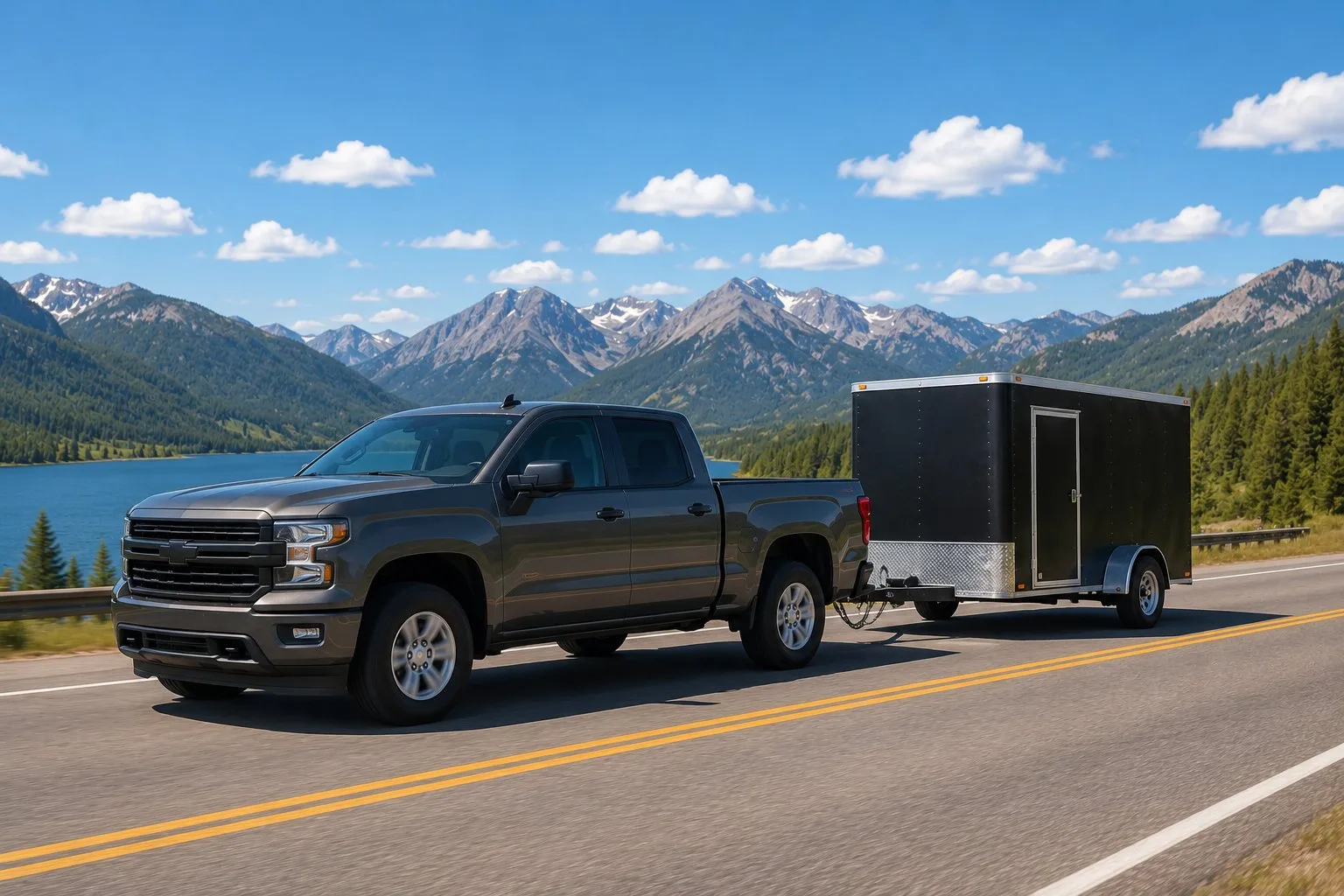
Understanding towing capacity vs payload capacity is critical for safe towing. These are the two most misunderstood numbers in towing. Most drivers know their truck’s towing capacity — it’s plastered all over the commercials. But far fewer know their payload capacity, and confusing the two is one of the fastest ways to damage your truck, void your warranty, and create a dangerous rig. Here’s how to understand both numbers, find them on your specific truck, and use them correctly every time you hitch up.
Not sure which limit you’ll hit first? Our free towing capacity calculator checks towing capacity and payload at the same time, using your trailer’s tongue weight.
Table of Contents
ToggleWhat Is Towing Capacity?
Towing capacity is the maximum weight your truck is rated to pull behind it — the total weight of the trailer plus everything loaded on the trailer. It’s determined by the manufacturer based on the truck’s engine, transmission, frame, brakes, cooling system, and hitch components.
A truck rated to tow 12,000 lbs can pull a trailer that weighs up to 12,000 lbs fully loaded. Exceed that, and you’re stressing every component in the drivetrain, shortening their service life, and creating a situation where your truck simply cannot stop the combined weight in an emergency.
READY TO STOP GUESSING?
LEARN THE RIGHT WAY. BUILD THE SKILLS TO TOW MORE SAFELY.
Build the skills to tow more safely. 51 video lessons, one-time payment.
ENROLL NOWOne-time payment - 30-Day money-back guarantee
Key point: Towing capacity is the weight of the trailer, not counting what’s in the truck cab or bed.
What Is Payload Capacity?
Payload capacity is the maximum weight your truck can carry inside and on top of the vehicle itself — passengers, cargo in the bed, and the tongue weight of your trailer. It’s the total weight that can be placed on the truck’s frame and suspension.
Payload capacity is determined by the truck’s GVWR (Gross Vehicle Weight Rating) minus its curb weight:
Payload Capacity = GVWR − Curb Weight
Example: If your truck has a GVWR of 7,000 lbs and a curb weight of 5,200 lbs, your payload capacity is 1,800 lbs. That 1,800 lbs must cover everything — you, your passengers, gear in the cab, cargo in the bed, AND the tongue weight of your trailer.
Why Tongue Weight Matters for Payload
Watch a Free Lesson
See how TowPro Academy teaches it step by step. Jeff McDonough, the founder, has 10+ years and 250,000+ miles of towing behind him.
This is where most towers get into trouble. Tongue weight — the downward force your trailer puts on your hitch ball — counts against your payload capacity, not just your towing capacity. Many drivers focus entirely on whether their trailer weight is under the towing limit and never think about payload at all. If you tow with a weight distribution hitch, see our weight distribution hitch setup guide for how to set it up correctly.
Example: You’re towing a 10,000 lb trailer. Tongue weight is 12% = 1,200 lbs. You have two passengers (400 lbs) and 200 lbs of gear in the bed. Total payload used: 1,800 lbs.
If your truck’s payload capacity is only 1,500 lbs, you’re already 300 lbs over — even though the trailer is well within the towing rating. This is overloading the rear suspension and axle, not the drivetrain.
How to Find Your Truck’s Actual Payload Capacity
There are three places to find your truck’s specific payload capacity:
1. The Door Jamb Sticker
Open the driver’s side door and look at the sticker on the door jamb or B-pillar. It lists the GVWR, GAWR (Gross Axle Weight Ratings), and often the payload capacity directly. This is your truck’s actual, build-specific number — not the marketing number from the brochure.
Free Download
Never Miss a Safety Check Again
The exact 66-point checklist Jeff runs before every tow, so small problems get caught before they become breakdowns. Enter your email and we will send it over.
Free PDF · Instant download · No spam, unsubscribe any time
2. The Owner’s Manual
Your owner’s manual has a towing and payload section with detailed tables based on engine, cab configuration, bed length, and drivetrain. This is the most complete reference for your specific configuration.
3. The Manufacturer’s Towing Guide
Ford, Ram, Chevy, GMC, and Toyota all publish annual towing guides (usually available as PDFs on their websites). These show maximum towing and payload numbers broken down by exact trim level, engine, axle ratio, and equipment package.
Important: Never use the maximum advertised towing capacity as your number. That figure is for a perfectly configured truck with the max tow package, heaviest axle ratio, and no passengers. Your actual truck — with your specific options and a person in the seat — will have a lower number. Use the door jamb sticker.
The Difference Between GVWR, GCWR, and GAWR
These acronyms appear on every truck sticker and in every towing guide. Here’s what they mean:
- GVWR (Gross Vehicle Weight Rating): The maximum allowable total weight of the truck itself — curb weight plus everything in and on it. Exceeding GVWR overloads the truck’s frame, suspension, and axles.
- GCWR (Gross Combined Weight Rating): The maximum allowable total weight of the truck AND the trailer together. This is the ceiling for the entire rig.
- GAWR (Gross Axle Weight Rating): The maximum weight each axle can support. Listed separately for front and rear. You can be within GVWR overall but still overload an individual axle.
- GTW (Gross Trailer Weight): The total weight of the trailer fully loaded. Must not exceed the truck’s towing capacity.
- TW (Tongue Weight): The downward force at the hitch. Should be 10–15% of GTW and must fit within the truck’s payload capacity.
Real-World Example: Running the Numbers
Let’s say you have a half-ton pickup with these specs from the door jamb sticker:
- GVWR: 7,100 lbs
- Curb weight: 5,400 lbs
- Payload capacity: 1,700 lbs
- Maximum towing capacity: 11,000 lbs
You want to tow a 9,000 lb travel trailer. Tongue weight at 12% = 1,080 lbs.
Check towing capacity: 9,000 lbs vs. 11,000 lb limit → ✅ Fine
Check payload: 1,080 lbs tongue weight + 200 lbs driver and passenger + 150 lbs gear in bed = 1,430 lbs vs. 1,700 lb payload → ✅ Fine, with 270 lbs to spare
Both checks pass. You’re good to go. But if you added another passenger and loaded the bed with 300 lbs of camping gear, you’d be at 1,780 lbs — 80 lbs over payload. A small margin on paper, but consistent overloading wears out rear springs, wheel bearings, and brake components prematurely.
Half-Ton vs. Three-Quarter-Ton vs. One-Ton: Why It Matters
The truck classification (1/2-ton, 3/4-ton, 1-ton) historically referred to payload capacity, though modern trucks exceed those numbers significantly.
- Half-ton trucks (F-150, Ram 1500, Silverado 1500): Typical payload 1,400–2,300 lbs. Towing capacity up to 13,000–14,000 lbs depending on configuration. Best for travel trailers under 8,000 lbs GTW.
- Three-quarter-ton trucks (F-250, Ram 2500, Silverado 2500): Typical payload 2,000–3,800 lbs. Towing capacity up to 20,000 lbs. Handle heavier fifth wheels, horse trailers, and large RVs.
- One-ton trucks (F-350, Ram 3500, Silverado 3500): Typical payload 3,500–7,000+ lbs (dually configurations). Towing capacity up to 40,000 lbs on diesel dually models. Required for large fifth wheels and commercial trailers.
Common Mistakes That Overload Payload
- Ignoring tongue weight in the payload calculation: It’s the most common error. Tongue weight is real weight on your truck.
- Using the advertised max capacity instead of the door jamb number: The sticker is your truck. The brochure number is a different truck.
- Not accounting for aftermarket add-ons: Lift kits, heavy bumpers, winches, toolboxes, bed liners — all of this adds curb weight and reduces your remaining payload.
- Filling the bed AND towing a heavy trailer: Both payload and towing capacity are being consumed simultaneously. Run both calculations every time.
Towing Capacity vs Payload Capacity: Bottom Line
Towing capacity tells you how much your trailer can weigh. Payload capacity tells you how much weight your truck can carry — and tongue weight counts against that number. Both limits apply every time you hitch up, and both must be respected. Check the door jamb sticker, run the numbers before every trip, and tow within the ratings your truck was actually built to handle. The NHTSA trailer towing guidelines explain how GVWR, GCWR, and payload interact — and why exceeding any one of them creates an unsafe condition regardless of the others.
TowPro Academy’s towing course teaches you how to read your truck’s ratings, properly match a trailer to your vehicle, and set up your rig safely from the start. Enroll for $79 — one-time payment, access for as long as the course is hosted, 51 video lessons.
Related Articles
- What Is Payload Capacity?
- What Is GVWR?
- What Is GCWR?
- Towing Capacity Explained
- Towing Glossary: Every Key Towing Term Defined
Ready to Tow With Confidence?
TowPro Academy is a trailer towing course built for truck owners who tow their own trailers. 51 lessons covering everything from hookup to backing up — one-time payment, learn at your own pace.
📖 New to towing? Start with our structured Beginner Towing Guide — organized from basics to advanced, all in one place.
Stop guessing. Start towing with confidence.
The TowPro Course walks you through every skill in real road scenarios.
Step-by-step video lessons, a final exam, and printable lesson guides and checklists — everything in one place for $79 (fall special, reg. $99).
Enroll Now — $79 (Fall Special, reg. $99) →Read Next
- What Is GVWR?
- What Is Payload?
- What Is Tongue Weight?
- Towing Capacity Guide
- What Is Towing Capacity?
- Full Towing Glossary
Learn It Right the First Time
- 51 video lessons, hitching to backing to emergencies
- 950+ pages of PDF guides and checklists
- Final exam: score 80% to earn your certificate of completion
- 30-day refund if it is not for you
$79 through Oct 31 (regularly $99)
Frequently Asked Questions
What is the difference between towing capacity and payload capacity?
Towing capacity is the maximum trailer weight your vehicle can pull, while payload capacity is the maximum weight it can carry inside, including passengers, cargo, and trailer tongue weight. Both limits must be respected.
Why does payload matter when towing?
Because the trailer’s tongue weight counts against your payload. You can be under your tow rating but still overload the truck once passengers, cargo, and tongue weight are added, so always check payload too.
Where do I find my truck’s towing and payload numbers?
Check the door-jamb sticker for payload and the owner’s manual or manufacturer’s towing guide for tow ratings specific to your engine, axle ratio, and configuration — not the model’s maximum.
What happens if I exceed towing or payload capacity?
Exceeding either rating strains the brakes, tires, transmission, and frame, increasing the risk of failure and loss of control. It can also void your warranty and violate towing laws.
About the Author
Jeff McDonough
Founder of TowPro Academy, 10+ years and 250,000+ miles of towing experience.
He built TowPro Academy to give everyday trailer owners a clear, step-by-step way to learn what he learned on the road.
Read Full Bio →RELATED ARTICLES
- ›Night Towing: Tips and Techniques for Safe After-Dark Driving
- ›How to Buy a Used Trailer: What to Look For Before You Commit
- ›Towing Laws by State: What Every Driver Needs to Know
- ›Trailer Maintenance Schedule: What to Inspect, When, and Why
Ready to put it all together? Enroll in TowPro Academy and master safe towing in 51 step-by-step lessons.