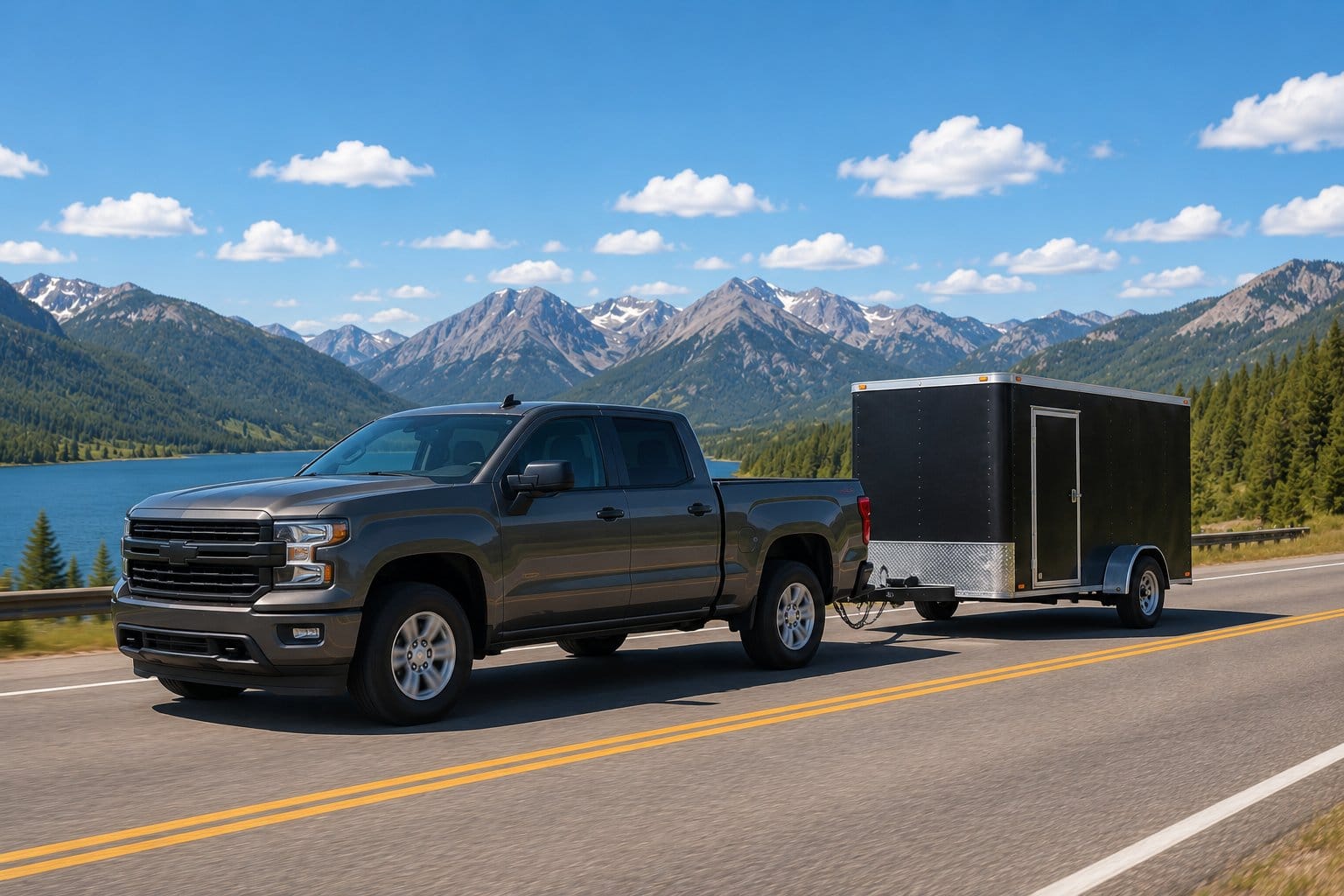
Search for “best half-ton truck for towing a travel trailer” and you will find lists ranked by maximum tow rating. That big number is the wrong place to start. For most travel trailer owners, the limit you hit first is payload: how much weight the truck can carry in its cab and bed, including the trailer’s tongue weight.
Want to check your own setup? Plug your numbers into our free towing capacity calculator to see how your truck and trailer match up.
Two trucks of the same make and model can have very different payloads depending on cab size, bed length, engine, axle ratio, trim and options. So the honest answer to “which half-ton is best” is: the one whose own door-jamb numbers cover your trailer, your passengers and your gear. This guide shows you how to do that math.
Why Payload Usually Runs Out First
A manufacturer’s maximum tow rating is usually calculated for a specific configuration, often a lightly optioned truck with a driver only. Once you add passengers, a weight distribution hitch, coolers, firewood, a generator, and the trailer’s tongue weight, you are spending payload.
Travel trailers carry a lot of weight on the tongue. A common guideline is that tongue weight should be about 10 to 15 percent of the loaded trailer weight. Check your trailer manufacturer’s recommendation. We explain why in Trailer Tongue Weight: The 10-15% Rule. That tongue weight sits on the truck and counts against payload.
For the full comparison, see Towing Capacity vs. Payload Capacity.
Where to Find Your Truck’s Real Numbers
Don’t trust brochures, dealer claims or online averages. Look at your truck:
READY TO STOP GUESSING?
LEARN THE RIGHT WAY. BUILD THE SKILLS TO TOW MORE SAFELY.
Build the skills to tow more safely. 51 video lessons, one-time payment.
ENROLL NOWOne-time payment - 30-Day money-back guarantee
- The Tire and Loading Information placard on the driver’s door jamb (B-pillar). It typically says something like “The combined weight of occupants and cargo should never exceed XXX lbs.” That number is your truck’s payload as built.
- The Safety Compliance Certification Label, also on the driver’s door jamb area, lists GVWR (gross vehicle weight rating) and GAWR (front and rear axle ratings). Learn more in What Is GVWR?
- The owner’s manual and the manufacturer’s towing guide for your model year, which give GCWR (gross combined weight rating) and the maximum trailer weight for your exact configuration. See What Is GCWR? and How to Read Your Truck’s Towing Specs.
Most full-size truck makers publish an annual RV and trailer towing guide on their official sites (for example Ford, Ram, Chevrolet, GMC, Toyota and Nissan). Use the guide for your model year, and match the cab, bed, engine and axle ratio exactly.
The Payload Math, Step by Step
Watch a Free Lesson
See how TowPro Academy teaches it step by step. Jeff McDonough, the founder, has 10+ years and 250,000+ miles of towing behind him.
Here is the worksheet. Use your real numbers, not ours.
Free Download
Never Miss a Safety Check Again
The exact 66-point checklist Jeff runs before every tow, so small problems get caught before they become breakdowns. Enter your email and we will send it over.
Free PDF · Instant download · No spam, unsubscribe any time
Step 1: Start with door-jamb payload.
Payload available = number on the Tire and Loading placard.
Step 2: Subtract everything in the truck.
– Driver and passengers (actual weights)
– Pets
– Cargo in the cab and bed (coolers, tools, firewood, generator, bikes)
– Aftermarket accessories added after the truck left the factory (bed cover, toolbox, larger tires, step bars). These generally are not reflected on the placard.
– The weight of the hitch itself, especially a weight distribution hitch head and bars (check the hitch manufacturer’s spec)
Step 3: Subtract the trailer’s tongue weight.
Estimate loaded tongue weight as 10–15% of your trailer’s loaded weight, or better, weigh it. Do not use the brochure “dry weight”. Trailers leave the lot with batteries, propane, options and dealer add-ons, and you will add water, food and gear.
Step 4: What is left must be zero or more, with a margin.
If the result is negative, the truck is over payload with that trailer and load, even if the trailer is well under the tow rating.
Worked example (illustrative numbers only)
Suppose a truck’s placard says occupants and cargo should not exceed 1,500 lbs. (This number is invented for the example. Use yours.)
| Item | Weight (example) |
|---|---|
| Driver + passenger + two kids | 520 lbs |
| Dog, cooler, gear in bed | 180 lbs |
| Bed cover + toolbox (aftermarket) | 90 lbs |
| Weight distribution hitch | 100 lbs |
| Payload used before trailer | 890 lbs |
| Payload remaining | 610 lbs |
At 13% tongue weight, 610 lbs of remaining payload supports a loaded trailer of about 4,700 lbs (610 ÷ 0.13). The tow rating on the same truck might be far higher, but in this example, payload sets the limit.
Then check the other ratings too: the loaded truck must stay under GVWR, each axle under its GAWR, the combination under GCWR, and the trailer under its own GVWR. A trip to a certified scale is the only way to know for sure. See How to Weigh a Trailer.
What to Look for When Shopping for a Half-Ton to Tow
Instead of ranking brands, use this checklist on any half-ton you are considering:
- Read the placard on the actual truck on the lot. Two trucks side by side can differ.
- Ask about factory towing or payload packages for that model year, and confirm them on the build sheet or window sticker.
- Check the axle ratio and engine against the manufacturer’s towing guide.
- Look for an integrated trailer brake controller or plan to add one. See our brake controller guide.
- Factor in mirrors and wheelbase. Longer wheelbases are generally more stable with long trailers. Pair this with proper sway control and a correctly set weight distribution hitch.
- Check the tires’ load rating (the sidewall and the placard), not just the size.
When a Half-Ton Is Not the Right Tool
If your math is tight, you have three honest options: carry less in the truck, choose a lighter trailer, or step up to a three-quarter-ton truck. Riding right at the limit leaves no margin for a full water tank, an extra passenger, or a hot day climbing a grade. See Selecting the Right Tow Vehicle for Your Travel Trailer.
Learn the Whole System
Matching the truck is step one. The TowPro Academy course walks through weight ratings, hitching, weight distribution, sway, brakes and driving technique in 51 short video lessons across 6 modules, with 950+ pages of downloadable lesson guides. Finish with a 50-question final exam and earn a certificate of completion by scoring 80% or higher. See the course.
Learn It Right the First Time
- 51 video lessons, hitching to backing to emergencies
- 950+ pages of PDF guides and checklists
- Final exam: score 80% to earn your certificate of completion
- 30-day refund if it is not for you
$79 through Oct 31 (regularly $99)
FAQ
Can a half-ton truck tow a travel trailer?
Many can, but whether yours can tow your trailer depends on its door-jamb payload, GVWR, GCWR, axle ratings and the trailer’s loaded weight. Do the payload math above.
Where do I find my truck’s payload?
On the Tire and Loading Information placard on the driver’s door jamb. It shows the maximum combined weight of occupants and cargo.
Does tongue weight count against payload?
Yes. The trailer’s tongue weight, and the weight of the hitch, ride on the truck and count toward payload.
Should I use the trailer’s dry weight?
No. Use the loaded weight (or the trailer’s GVWR for a conservative estimate), and weigh the rig at a scale when you can.
Stop guessing. Start towing with confidence.
The TowPro Course walks you through every skill in real road scenarios.
Step-by-step video lessons, a final exam, and printable lesson guides and checklists — everything in one place for $79 (fall special, reg. $99).
Enroll Now — $79 (Fall Special, reg. $99) →RELATED ARTICLES
- ›Do Utility Trailers Need a Weight Distribution Hitch?
- ›Weight Distribution Hitches for Flatbed Trailers Guide
- ›Weight Distribution Hitches for Dump Trailers Explained
- ›Trailer Hitch Classes Explained: Class I, II, III, IV & V
Ready to put it all together? Enroll in TowPro Academy and master safe towing in 51 step-by-step lessons.