
Learning how to back up a trailer is one of the most intimidating skills a new tower faces — and one of the most satisfying to master. Unlike driving forward, where your instincts work with you, reversing with a trailer requires you to temporarily rewire how your hands and eyes work together. The good news is that with the right technique and consistent practice, backing up a trailer becomes second nature for any driver.
At TowPro Academy, backing up a trailer is one of the first practical skills we walk drivers through — because the fear of reversing keeps more people from towing than almost anything else. This guide gives you the foundational techniques, the mental model, and the step-by-step process to back up a trailer with confidence.
TowPro Academy Course
Stop Guessing. Start Towing Right.
51 video lessons • 950+ pages of downloadable lesson guides • 6 modules • 30-day money-back guarantee. Jeff covers every topic in this article and more — step by step, on video.
Enroll Now — $79 through Oct 31 (regularly $99)Access for as long as the course is hosted • No subscriptionNot sure your setup is within limits? Check it in 30 seconds with our free towing capacity calculator.
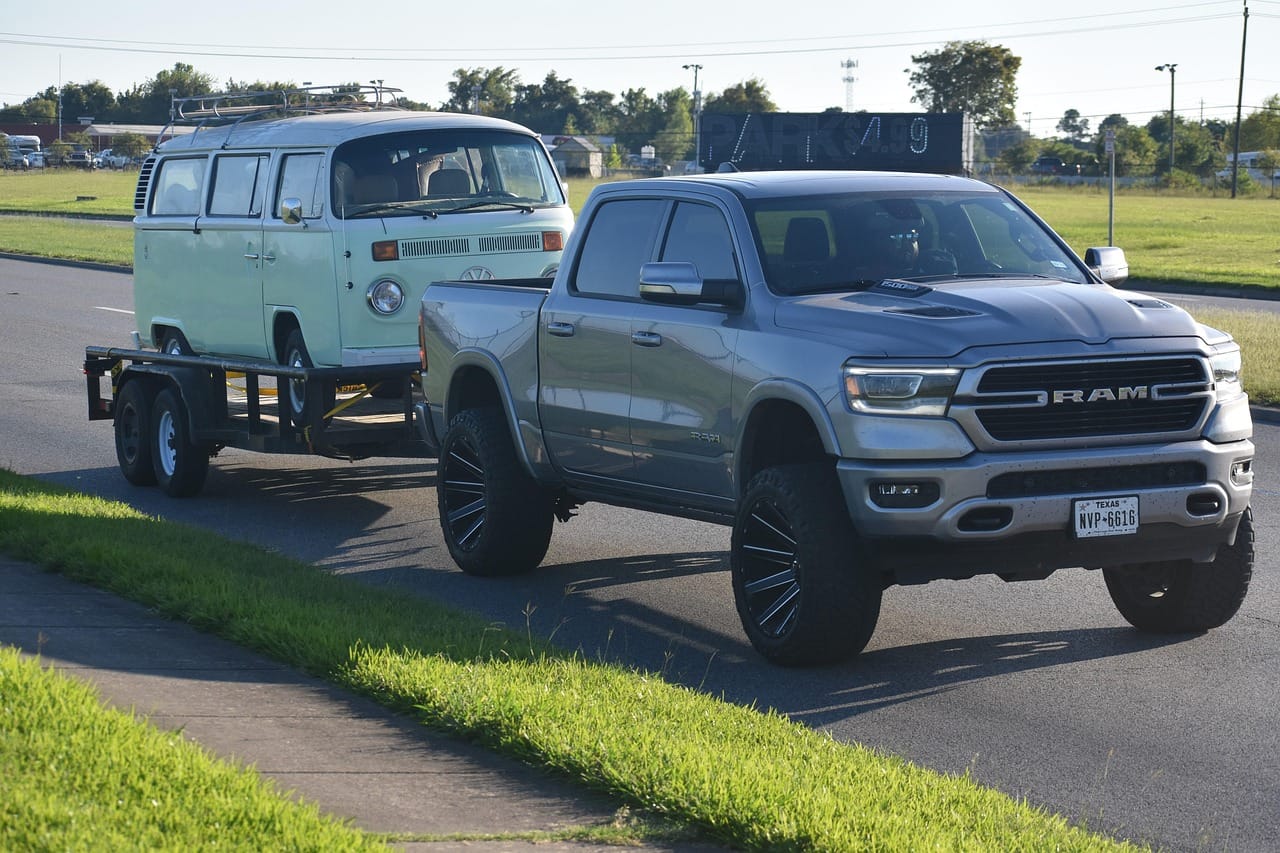
Quick Steps: How to Back Up a Trailer
- Walk the area and set up a straight approach, or a gentle angle.
- Put one hand at the bottom of the steering wheel.
- Move that hand toward the side you want the back of the trailer to go.
- Reverse at crawl speed and keep steering inputs small.
- Check both mirrors in turn. Once the trailer is on line, straighten the wheel.
- If the angle gets too sharp, pull forward and reset.
Why Backing Up a Trailer Feels Backwards
When you back up a trailer, the trailer turns in the opposite direction from your steering wheel — at least initially. This counterintuitive movement is what trips up most drivers. Your instinct says “turn right to go right,” but when you’re reversing with a trailer attached, turning your wheel right actually sends the trailer left. Understanding this fundamental principle is the first step to learning how to back up a trailer properly.
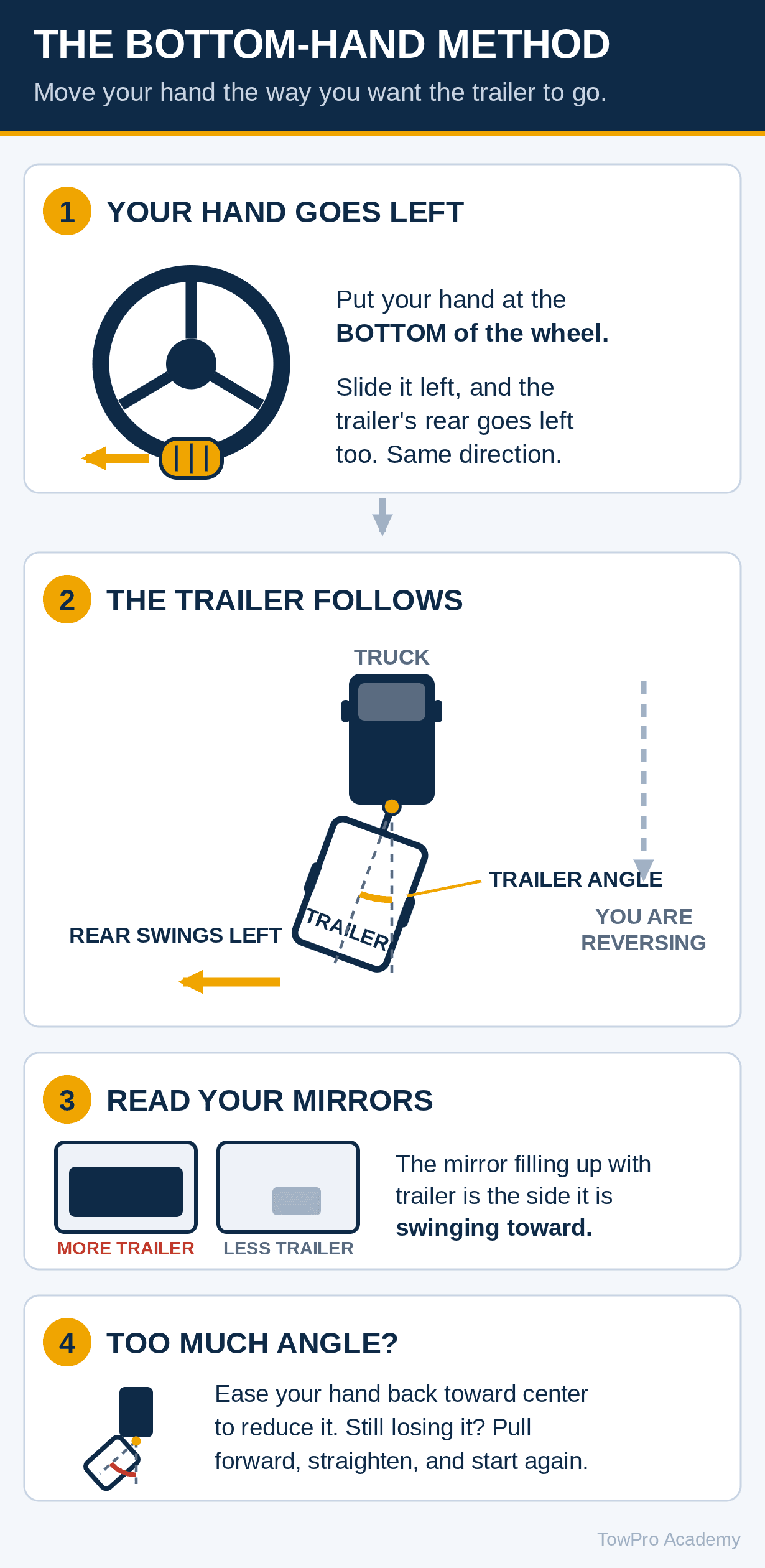
The key mental trick that makes this easier: focus on the rear of the trailer, not the front of your truck. Place your hand at the bottom of the steering wheel and move it in the direction you want the back of the trailer to go. Want the trailer to go left? Move your hand left. This “bottom-hand” method is the simplest way most drivers learn to back up a trailer without confusion.
The Bottom-Hand Method: The One Habit That Fixes Everything
If you only take one thing from this guide, take this. Move your hand to the bottom of the steering wheel — the 6 o’clock position — and then move that hand in the direction you want the rear of the trailer to go.
READY TO STOP GUESSING?
LEARN THE RIGHT WAY. BUILD THE SKILLS TO TOW MORE SAFELY.
Build the skills to tow more safely. 51 video lessons, one-time payment.
ENROLL NOWOne-time payment - 30-Day money-back guarantee
- Want the back of the trailer to swing left? Move your bottom hand left. (The truck’s wheels actually turn right.)
- Want the back of the trailer to swing right? Move your bottom hand right. (The truck’s wheels actually turn left.)
That is the whole trick. Steering from the top of the wheel forces you to do the mental inversion every single time, and under pressure most people get it wrong. Steering from the bottom removes the inversion entirely, because your hand and the trailer now move the same way. It feels like cheating. It is not — it is what makes the difference between guessing and knowing.
Practise it deliberately for the first few sessions until you stop thinking about it. Once the bottom-hand habit is automatic, the rest of backing up a trailer is just speed control and patience.
How to Back Up a Trailer: Step-by-Step
Step 1: Set Up Your Approach
Before you ever begin reversing, position your truck and trailer so that you have a straight line to your target or a gentle angle that gives you room to correct. Get out and walk the area first — identify your target, any obstacles, and how much space you have. Knowing your environment before you start makes every reversal easier.
Step 2: Go Slow
Speed is your enemy when backing up a trailer. The slower you go, the more time you have to make corrections before a small angle becomes a big problem. Crawl speed is the correct speed. If your trailer starts going the wrong way, it’s always easier to pull forward and reset than to try to recover from a bad angle at speed.
Step 3: Use Small Steering Inputs
Large steering movements create large, fast angles between your truck and trailer — and once the trailer folds up too sharply (a situation called “jackknifing”), it’s very hard to recover without pulling forward. Use small, gradual steering inputs and constantly watch your mirrors to monitor where the trailer is going. When the trailer is on the line you want, straighten your wheel to keep it tracking straight.
Step 4: Use Your Mirrors — Both of Them
Your side mirrors are your most important tools when you back up a trailer. Adjust them before you start so you can see the full length of the trailer on each side. You want to see both the side of the trailer and the ground behind it. Check both mirrors alternately — not just one. When one mirror shows the trailer moving toward an obstacle, correct before it gets worse.

Step 5: Pull Forward and Reset When Needed
Pulling forward to reset your angle is not failure — it’s professional technique. Every experienced tower does it. If you find your trailer at a bad angle or heading toward an obstacle, pull forward to straighten out the rig and start again with a better approach. It’s always better to take three attempts cleanly than to force a bad angle and cause damage.
How to Back Into a Spot (Offset Backing)
Backing straight is the drill. Backing into a spot is the real-world job — a campsite, a driveway, a loading bay, a slot between two other trailers. The maneuver has a name, offset backing, and it has a repeatable sequence.
- Walk it first. Get out and look. Note the low branch, the water spigot, the fire ring, the curb you cannot see from the driver’s seat. Thirty seconds of walking saves most bent bumpers.
- Set up the approach. Drive past the opening and stop so the trailer is offset from the spot rather than square to it. You want an angle to swing into, not a 90-degree corner to fight.
- Start the swing. Using the bottom-hand method, steer to push the rear of the trailer toward the opening. Idle speed only.
- Read both mirrors. Watch the trailer swing toward the target. When it is aimed into the spot, begin straightening the truck so it follows the trailer in.
- Finish straight. Once the trailer is lined up, straighten out and back straight in, checking clearances on both sides as you go.
Know the point of no return. Once the angle between truck and trailer gets sharp — roughly past 90 degrees — you cannot steer out of it. You have to pull forward and reset. Recognising that moment early is a skill in itself, and it is the difference between a reset and a creased fender.
If you have a spotter, agree on signals before you start. Shouting across a parking lot fails every time. Settle on a hand signal for “keep coming”, one for “stop”, one for distance remaining, and one for “pull forward and reset”. The spotter stands where the driver can see them in a mirror, never directly behind the trailer.
Watch a Free Lesson
See how TowPro Academy teaches it step by step. Jeff McDonough, the founder, has 10+ years and 250,000+ miles of towing behind him.
Free Download
Never Miss a Safety Check Again
The exact 66-point checklist Jeff runs before every tow, so small problems get caught before they become breakdowns. Enter your email and we will send it over.
Free PDF · Instant download · No spam, unsubscribe any time
How to Back Up a Boat Trailer Down a Ramp
A boat ramp uses the same bottom-hand method, with a slope, wet pavement and usually a line of people waiting. Prep away from the ramp and you will spend very little time on it.
- Prep in the staging area, not on the ramp. Remove the tie-down straps (keep the bow strap and winch attached), put in the drain plug, load your gear and disconnect the trailer lights if they are not waterproof.
- Line up straight. Pull forward past the ramp and swing wide, so the truck and trailer are straight and pointed down the middle of the ramp before you start reversing. Starting straight is most of the job.
- Back slowly using both mirrors. Keep your hand at the bottom of the wheel and make small corrections. On a slick ramp, crawl speed is more important than ever.
- Watch the fenders, not the water. A common reference: back in until the trailer fenders are near the waterline or just under it. The right depth depends on your boat and trailer (bunk vs. roller), so learn your own mark.
- Park it, set it, then launch. Shift to park, set the parking brake, and chock a wheel on steep or slick ramps. Keep the truck’s rear wheels out of the water.
- Retrieve the same way. Back in to a similar depth, center the boat on the trailer, winch it snug, and pull out slowly so the tires do not spin on the algae.
Tip: If you drift off-center halfway down, pull forward and reset. A clean second try is faster than fighting a crooked trailer on a slope.
How to Park a Trailer (Straight-Line, Pull-Through and 90-Degree Back-In)
Most trailer parking is one of three moves. Pick the easiest one the space allows.
1. Pull-Through Parking (Easiest)
When there are two open spots in a row, or a pull-through campsite, drive in and stop without reversing. Swing wide on the way in so the trailer wheels clear the curb. The trailer tracks inside your truck’s path through turns.
2. Straight-Line Parking (Curbside or Along a Fence)
- Pull forward past the spot until the truck and trailer are straight and parallel to the curb.
- Back straight in with small corrections. If the trailer drifts, move your bottom hand toward the side you want the trailer to go.
- Stop with a few feet of clearance behind the trailer so you can pull out easily.
3. 90-Degree Back-In (Driveways, Campsites, Parking Rows)
- Get out and look. Note posts, hookups, branches and the edges of the spot.
- Set up on the far side. Drive past the spot and position the truck so the rear of the trailer sits just past the opening. Most drivers find it easiest to back toward the driver’s side, where they can see the trailer turn through the window.
- Start the swing. Turn the wheel to push the trailer’s rear into the opening. Go slowly.
- Follow the trailer. When the trailer is aimed into the spot, steer the truck back under it so the rig straightens out.
- Finish straight. Back the rest of the way in a straight line, checking both mirrors and using a spotter if you have one.
Watch the angle between truck and trailer. If it closes past about 90 degrees, you cannot steer out of it, so pull forward and reset.
Practicing How to Back Up a Trailer
The only way to get good at backing up a trailer is practice — but practice the right way matters. Start in an empty parking lot with no obstacles and no time pressure. Set up a simple target (cones, a marked spot) and practice backing straight, then practice backing to the left and right at different angles. The more repetitions you get in a low-stakes environment, the more natural the movements become before you’re backing into a campsite or loading dock under pressure.
🔄 Practice Tip: Find an empty parking lot and set up a target with cones or chalk marks. Start with long, slow approaches and straight reverses before attempting angled backing. Practice 15–20 minutes twice a week and most drivers achieve solid confidence within 2–4 sessions.
This skill pairs directly with the foundation of real towing confidence — the more skills you own, the less stressful every towing situation becomes. And before any backing maneuver, make sure you’ve completed your pre-trip towing checklist so your trailer is properly set up and your mirrors are adjusted correctly.
Common Mistakes When Backing Up a Trailer
Knowing how to back up a trailer isn’t just about knowing what to do — it’s about recognizing and correcting the habits that make it harder. These are the most common mistakes drivers make, especially early on:
- Moving too fast: Speed is the enemy of trailer control. The faster you move, the less time you have to see and respond to the trailer’s direction. If your trailer is doing something unexpected, your first move is always to slow down.
- Making large steering corrections: Small inputs cause big trailer reactions. Drivers who crank the wheel dramatically when backing up a trailer almost always find themselves jackknifed or off-target. Think of it as making micro-adjustments, not full corrections.
- Not using both mirrors equally: Most drivers favor one side. This leads to blind spots that compound over distance. Make a conscious habit of checking both mirrors in alternating short glances — never fixate on one side.
- Stopping and staring: Backing up is a dynamic process. Drivers who stop the vehicle to “think about it” often lose their reference points. It’s often better to pull forward and reset than to try to puzzle it out from a dead stop.
- Not setting up the approach: Where you park before you back up determines how easy the backing maneuver will be. Drivers who don’t plan their approach angle often start backing at a disadvantage that compounds with every correction.
Tools and Equipment That Help You Back Up a Trailer
While how to back up a trailer is fundamentally a skill, there are tools that make the learning curve shorter and the process easier at every level:
- Extended tow mirrors: These are the single most impactful piece of equipment for backing and general towing visibility. If your mirrors don’t give you a clear view down both sides of the trailer, extended tow mirrors are a must-have.
- A backup camera: Many newer tow vehicles include integrated backup cameras with trailer detection. Even a basic aftermarket camera mounted on the back of the trailer dramatically improves situational awareness.
- A spotter: Having a trusted person outside the vehicle who can communicate clearly is one of the safest ways to back into a tight space, especially when visibility is limited. Establish hand signals before you start — shouting often leads to miscommunication.
- Cones or markers: During practice sessions, set up visual markers to simulate the boundaries of your target. This gives you reference points to aim for and helps develop spatial awareness without the pressure of a real situation.
The National Institute for Occupational Safety and Health (NIOSH) documents that backup accidents are among the most common incidents for drivers operating larger vehicles and equipment. Proper training and backup aids significantly reduce this risk.
Reversing a Trailer: Same Skill, Different Word
If you searched for how to reverse a trailer rather than how to back one up, you are in the right place — they are the same maneuver. “Backing up” is the common phrasing in the United States; “reversing” is more common in the UK, Australia and New Zealand, and in commercial and truck-and-trailer training. The physics, the mirrors and the bottom-hand method do not change.
A few notes for drivers coming at this from the truck-and-trailer side. A longer wheelbase on the tow vehicle makes the rig slower to react but more forgiving once it is moving — small inputs, longer wait for the response. A short-drawbar utility trailer is the opposite: quick, twitchy, and it jackknifes in a fraction of the distance. If you learned on one, expect the other to feel wrong for the first few attempts.
Travel trailers, fifth wheels and larger rigs add height and bulk rather than new technique. What actually changes is what you can see: taller sidewalls mean bigger blind spots, so mirror setup and a walk-around matter more, not less.
How TowPro Academy Teaches You to Back Up a Trailer
At TowPro Academy, we cover how to back up a trailer as one of the first hands-on skills in the curriculum — because we know it’s the one that causes the most anxiety for new towers. Our approach breaks it down into a logical progression:
- Understanding the fundamental geometry — why the trailer goes the opposite direction you steer, and how to use this to your advantage
- The step-by-step backing process in open areas before progressing to confined spaces
- Visual reference systems — what to look for in your mirrors and how to use your environment as a navigation aid
- The “pull-forward and reset” mentality that removes pressure and keeps you making progress instead of getting frustrated
- Practice drills you can do in any empty parking lot that build muscle memory in weeks, not years
Once you’ve mastered backing, it’s important to also practice in challenging conditions — check our guide on towing safely in bad weather to prepare for real-world scenarios. If you’re ready to build this skill with structured guidance rather than trial and error, TowPro Academy’s towing confidence course gives you everything you need to go from nervous to capable behind the wheel.
Back Up a Trailer with Confidence
📚 Additional Resource: The RV Dealers Association (RVDA) provides a consumer guide to safe trailering that covers backing, hitching, and towing fundamentals helpful for all trailer drivers.
Learning how to back up a trailer is one of the most rewarding skills in towing — once it clicks, it stays with you. At TowPro Academy, we break this technique down into clear, step-by-step instruction designed for trailer drivers who want to tow safely and with real skill. If you’re ready to stop dreading the reversal and start doing it confidently, this is where that journey begins.
For step-by-step guidance on every aspect of trailer towing — not just backing — visit TowPro Academy, the most comprehensive truck towing course available.
Learn It Right the First Time
- 51 video lessons, hitching to backing to emergencies
- 950+ pages of PDF guides and checklists
- Final exam: score 80% to earn your certificate of completion
- 30-day refund if it is not for you
$79 through Oct 31 $99
Frequently Asked Questions: Backing Up a Trailer
Why does backing up a trailer feel backwards?
Backing up a trailer feels counterintuitive because the trailer responds inversely to steering inputs. When you turn left, the back of your truck moves left — but this swings the back of the trailer to the right. The bottom-hand rule makes this predictable: the trailer goes the direction your bottom hand points on the steering wheel.
What is the bottom-hand method for backing a trailer?
Place one hand at the bottom of the steering wheel (6 o’clock). To make the trailer go left, move your bottom hand left. To make it go right, move your bottom hand right. Use small, slow inputs — trailer steering is amplified. This method directly corresponds to the direction the rear of the trailer will travel.
What is jackknifing and how do I avoid it?
Jackknifing occurs when the trailer folds too sharply toward the tow vehicle — past 90 degrees — causing loss of control. To avoid it: use small steering inputs, go very slowly, and watch both mirrors simultaneously. As soon as the trailer approaches a sharp angle, pull forward to straighten out and reset. There’s no shame in pulling forward — it’s what experienced towers do.
How do I back a trailer in a straight line?
Backing in a straight line is harder than making turns because any deviation is self-reinforcing. Technique: start perfectly straight, make tiny corrections the moment the trailer begins to drift, and alternate small left-right inputs to maintain alignment. Use both side mirrors simultaneously — not just one.
How long does it take to learn to back up a trailer?
Most drivers can handle basic backing and simple turns in 2–4 hours of practice in an empty parking lot. Backing into a tight campsite or parallel parking takes 10–20 hours of consistent practice before feeling comfortable. TowPro Academy’s video lessons teach the bottom-hand method to accelerate this learning curve significantly.
How do you back a boat trailer down a ramp?
Line the truck and trailer up straight with the ramp before reversing. Put one hand at the bottom of the wheel and back slowly, using both mirrors. Stop when the trailer fenders are near the waterline. Then set the parking brake before launching.
What is the easiest way to park a trailer?
Pull-through parking is easiest because you never reverse. If you must back in, set up past the spot and back toward the driver’s side, where you can see the trailer through your window.
How do you back a trailer into a 90-degree spot?
Drive past the opening, turn the wheel to swing the trailer’s rear into the spot, then steer the truck back under the trailer to straighten it. Finish by backing straight in. If the angle gets too sharp, pull forward and reset.
Which side is easier to back a trailer toward?
The driver’s side. You can watch the trailer through your window as well as the mirror. Backing to the passenger side relies on the mirror alone, so a spotter helps.
Related Articles
- Trailer Sway Control: Why It Happens and How to Stop It
- First-Time Towing: What Nobody Tells You
- Start Here: Your First Steps to Safe Trailer Towing
- The Pre-Trip Towing Checklist Every Driver Needs
- Towing Glossary: Every Key Towing Term Defined
Stop guessing. Start towing with confidence.
The TowPro Course walks you through every skill in real road scenarios.
Step-by-step video lessons, a final exam, and printable lesson guides and checklists — everything in one place for $79 (fall special, reg. $99).
Enroll Now — $79 (Fall Special, reg. $99) →Read Next
- How to Back a Boat Trailer
- How to Parallel Park a Trailer
- Complete Beginner’s Guide to Trailer Towing
- What Is Trailer Sway?
- The Pre-Trip Towing Checklist
- Full Towing Glossary
RELATED ARTICLES
- ›Night Towing: Tips and Techniques for Safe After-Dark Driving
- ›How to Buy a Used Trailer: What to Look For Before You Commit
- ›Towing Laws by State: What Every Driver Needs to Know
- ›Trailer Maintenance Schedule: What to Inspect, When, and Why
Ready to put it all together? Enroll in TowPro Academy and master safe towing in 51 step-by-step lessons.

Hi, this is a comment.
To get started with moderating, editing, and deleting comments, please visit the Comments screen in the dashboard.
Commenter avatars come from Gravatar.